

Belgrade: The Energy of Freedom | Gaga Lomidze
05.11.2026 | 10 Min to readThis is my third time in Belgrade, but my first during such a turbulent period. For this reason, I find myself observing everything with heightened attention—the objects, the actions, the environment, and the people.
The countries of the former socialist bloc share a certain characteristic that is particularly striking and familiar to us as people from a former Soviet republic. But only at first glance: here, everything seems recognisable—the logic of human behaviour, the environment, even the jokes. Yet, it still seems to me that this is not entirely the case. You need only glimpse into an ordinary apartment in one of Belgrade's older residential buildings to realise that the interior here—the space where people spend most of their time and which shapes their consciousness—differs significantly from the interiors of Soviet-era apartments, which had, or still have, an aesthetic more akin to an over-decorated kitsch aesthetic: an excess of elements, patterned wallpaper on the walls, or colourful carpets and ornately carved furniture, adhering to the principle of "the more, the better."
This is understandable, as Serbia was never a direct neighbour of Soviet Russia. Therefore, an ordinary Belgradian apartment in an older building has more in common with a typical German flat. The city itself moves to a different rhythm; it is as if the air is infused with freedom—a light air of freedom which, as it turns out, completely contradicts the prevalent political narratives about it. At the same time, the political climate is tense, yet you will not find a heavy police presence anywhere on the streets.
A Student Rave
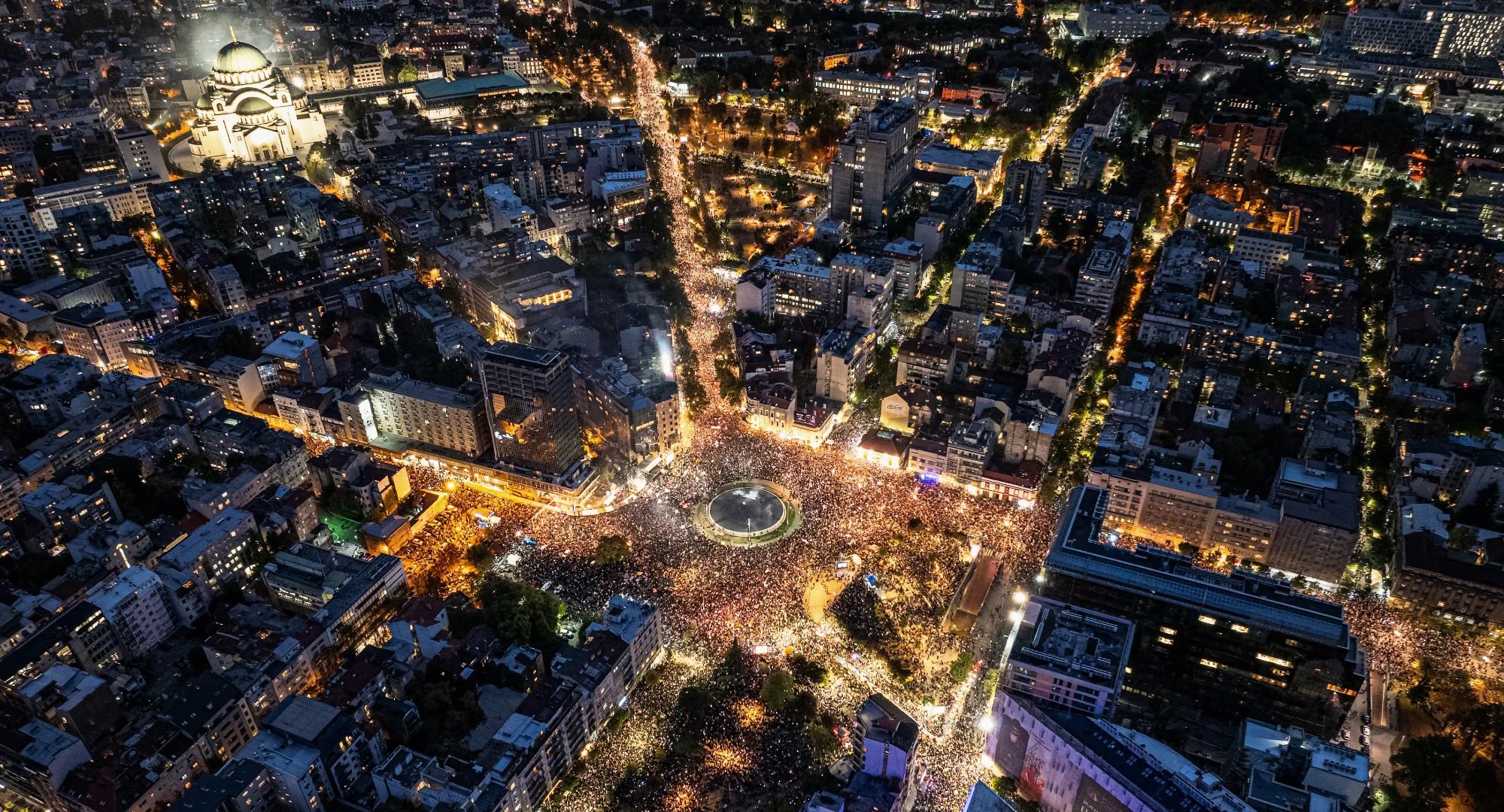
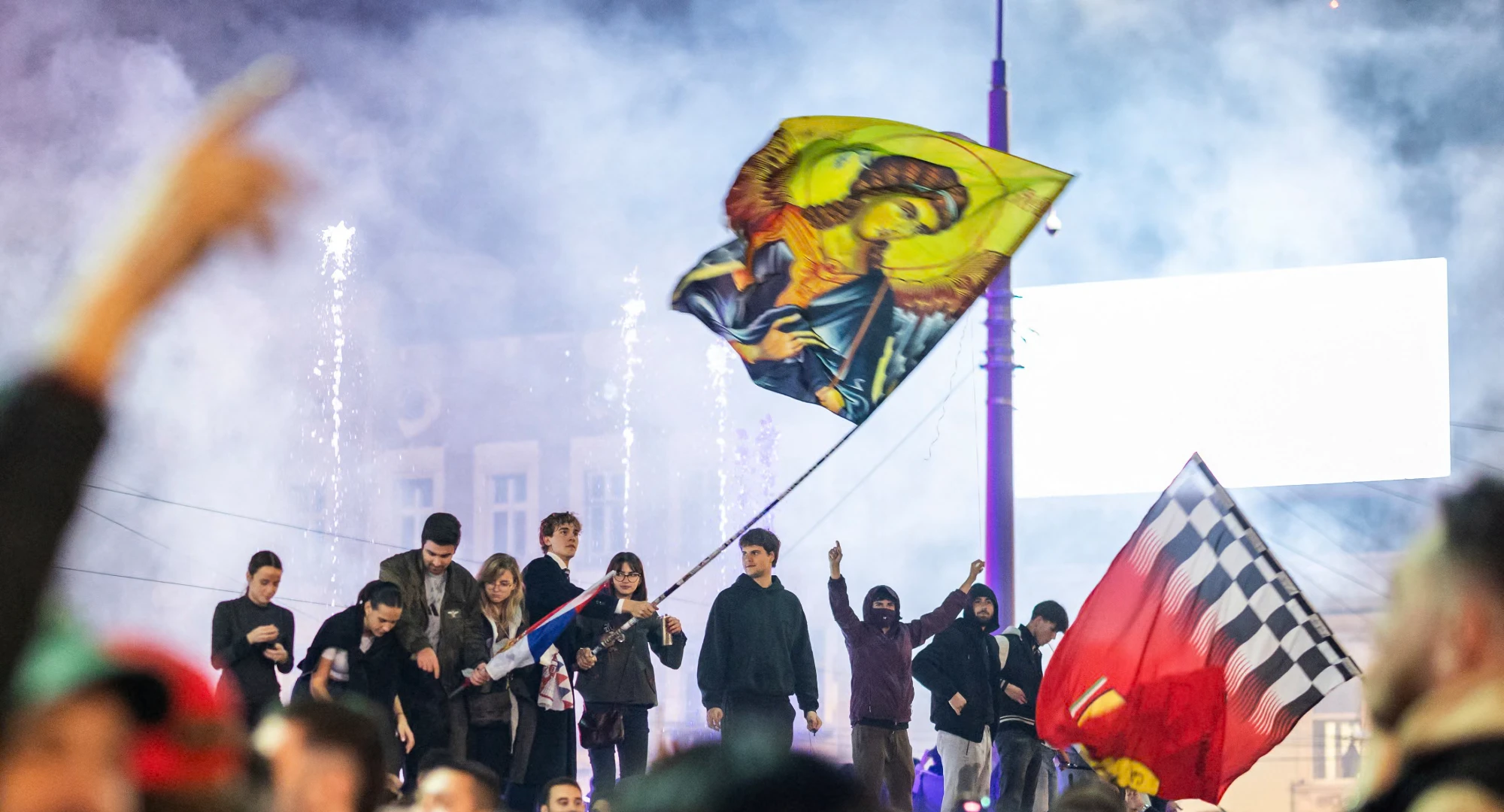
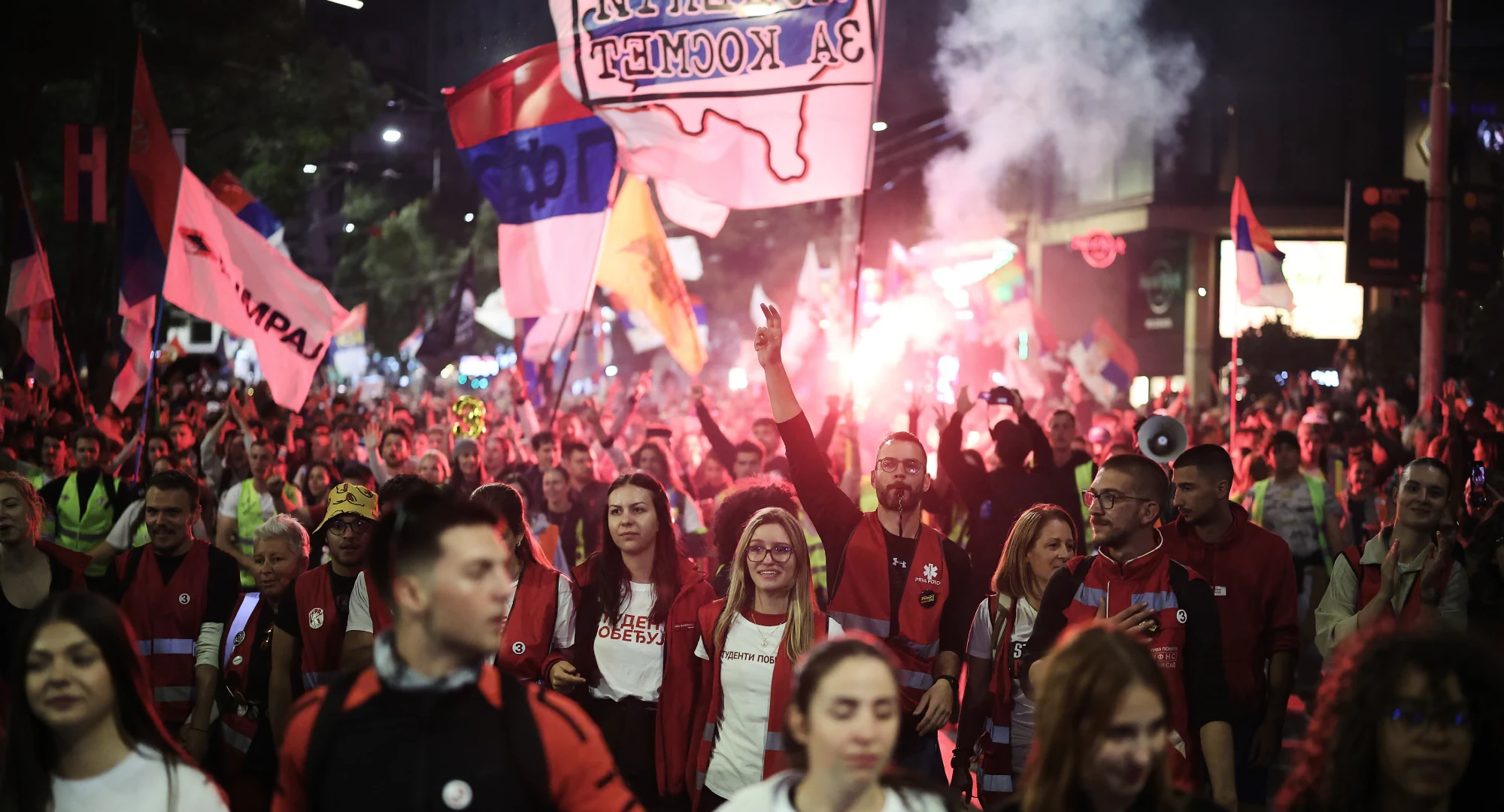
On my second day in Belgrade, just two days before the elections, I attended a demonstration. Countless young people with banners, alongside middle-aged individuals and the elderly, are converging on the city's central square. Amidst colourful smoke, there are demonstration slogans, accessories bearing the number 3 (the electoral number of the student movement), and rhythmic, song-like chants: "Vučić, ode!" ("Vučić, leave!").
Gradually, so many people gather in Belgrade's central square that I can no longer see where the flow begins or ends—every connecting street is overflowing.
And suddenly, for a moment, caught in the dense crush of people, I feel suffocated. Despite having attended many crowded rallies, I have never experienced anything like this. It later emerged that more than 150,000 people were out on the streets that day.
The sight of students treating the demonstrators to water and homemade sweets was also familiar. Nor was I surprised by the abundance of flags. What was slightly unusual was that some bore university emblems, while others featured religious symbols—Jesus and Orthodox saints. I saw no other symbols on these flags.
Marko Đurica/Reuters
The day after the rally, when I met with Aleksandra Krstić, a professor at the University of Belgrade's Faculty of Political Sciences, I asked her about this issue, to which she replied:
"At the student protest rally, there were no Serbian, European Union, American, or LGBTQ+ flags. They were students and, apart from the flags of their own universities and faculties, they had no other symbols. Also visible were flags depicting Serbian saints. Some of our pro-Western forces even asked: why don't they have EU flags? They didn't have them because it is the students' right not to. The movement was not associated with any specific political organisation. The European Union is a political organisation. Therefore, distancing themselves from any political label was, in a way, even beneficial for this movement. Later, some pro-Western forces concluded that the student movement had a more nationalist character. But such a one-sided assessment is also difficult to make, because the movement reflects a whole spectrum of people—from leftists to rightists, from believers to atheists, from heterosexuals to members of the LGBTQ+ community. It was precisely this diversity that proved to be the only way to resist the regime."
The Architecture of Power
Many actors are interested in the geopolitical situation of Serbia and the region as a whole. Among them is the European Union. Serbia's relationship with the EU alternates between love and hate. Over the last ten years, public support for EU integration has significantly decreased. If previously this figure was 70 per cent, it might now be around 40 per cent. On the other hand, the influence of far-right movements is growing, and nationalist rhetoric is intensifying. Against the backdrop of all this, Serbs are still trying to make the international community understand what is really happening. Last year, during the university blockades, they received immense support from the international academic community. Many professors came to express their solidarity. The academic community itself tried to amplify the students' voices. But foreign media only recently became interested in the events unfolding in Serbia. Initially, they covered the Serbian protests solely on an informational level. In the media of EU countries, more in-depth and substantive coverage of these events was rare, let alone in the American media.
Over the past five to ten years, the opposition in Serbia has been severely weakened. There was no longer a strong political opposition in parliament. Some political parties abandoned parliamentary life altogether.
Serbia's political landscape is highly fragmented: pro-European liberal and centrist groups; nationalist and conservative parties; leftist movements; environmental movements. These groups differed over Kosovo, relations with Russia, European integration, economic policy and Serbian national identity. The opposition boycotted the 2020 parliamentary elections, leaving the SNS (Serbian Progressive Party) with a massive parliamentary majority.
Vučić capitalised on the division within the opposition. He used nationalism and foreign policy to his advantage, particularly the Kosovo issue. He presented himself as the defender of Serbia's national interests; a politician who could maintain balanced relations with both Russia and the West; a guarantor of stability in a politically volatile region. This helped Vučić maintain international legitimacy, even as domestic democratic institutions deteriorated.
Ultimately, his party created a general environment in which the opposition was nullified. Freedom House, for example, describes instances of locally elected officials joining Vučić's party, the SNS, right after the elections were over. There were also reports of pressure on public sector employees and social assistance beneficiaries. Vučić's party also used state resources for its own benefit. Eventually, everyone became dependent on the ruling party, whether through financial benefits, employment or other long-term arrangements.
Armin Durgut/AP
Student protests began in 2023. A few months before the elections, a mass shooting took place in a primary school. A 13-year-old student killed nine schoolmates and one security guard. This was preceded by a narrative encouraging violence that had long dominated Serbian political culture: reality shows that turned personal conflict and humiliation into entertainment; tabloids that focused on violence and personal scandals; political debates in which insults and personal attacks took centre stage. Following the tragedy of May 2023, the UN Special Rapporteur on freedom of expression, Irene Khan, explicitly highlighted the hateful and divisive rhetoric in Serbian public discourse; she expressed concern over how political figures and media outlets facilitated the demonisation of independent journalists, human rights defenders, and political opponents. In July this year, members of such extremist groups attacked Vladimir Arsenijević, a writer and head of the KROKODIL cultural organization and festival. And in 2019, tabloids launched a campaign against Miodrag Sovilj, a journalist from the independent TV station N1, who asked questions about arms dealing by the father of the then-Minister of Internal Affairs and Vučić's connection to this case. The journalist was demanding explanations from the President. In response, pro-government tabloids published personal photos of Sovilj, portraying him as a consumer of alcohol and drugs.
"Serbia Against Violence"—throughout 2023, protest rallies were held under this very slogan, which also united the opposition. In December, early parliamentary and local government elections were held in major cities, which was undoubtedly an achievement of the protests. The demonstrations ceased for this reason, though it soon became apparent that nothing had changed—Vučić's regime remained in power, which became a great disappointment for opposition-minded Serbs.
According to the ODIHR, the elections were well-organised, although the SNS had a systemic advantage and misused state resources.
That same December, mass protests were held where the pro-European opposition coalition "Serbia Against Violence" and others demanded the annulment of the election results. But this was accompanied by an even greater intensification of pressure from the ruling party and dominant political forces on the opposition, government opponents, and anyone publicly criticising the regime—frequent absurd trials, unfair and inadequate fines...
All this was compounded by the deplorable state of Serbia's media environment. Among Serbians aged roughly 15 to 30, social media takes priority. However, Serbia has a relatively ageing population, so television remains the main source of information. And the television landscape is fully controlled by the party. Local media outlets, which received subsidies and funding from the state to continue broadcasting and operating, would in return disseminate information flattering the government. The four commercial television channels that have national broadcasting licences also supported Vučić.
Over the past two years, pressure on several independent TV channels, weeklies, and news publications has increased significantly.
Journalists working in critical media outlets were often portrayed by government-loyal media as enemies of Serbia, foreign agents, traitors, and purveyors of Western interests.
One way of bringing independent media outlets under control was to change their management structures. For example, the Portuguese investment company Alpac Capital acquired the independent television news channel N1, the TV channel Nova S, which focused on political reporting and investigative journalism, as well as one of Serbia's distinguished and critical newspapers, Danas, and the investigative and political weekly magazine, Radar. Behind this acquisition stands Pedro Vargas David—the company's CEO, whose father, Mário David, is a long-time political ally and adviser to Viktor Orbán. In this case, resistance from the journalists working at those outlets proved decisive. Journalists from N1, Nova S, Danas, and Radar continued their journalistic investigations into corruption and violations committed by the government, refusing to follow political directives. There was even a case this year when the deputy editor-in-chief of N1, Ratko Femić, publicly warned everyone that his newsroom would not allow the publication to be turned into a propaganda tool. Journalists participated in demonstrations and organised protest rallies themselves against intimidation, political interference, and the unequal conditions present in the media environment. In this regard, the 2023 movement "Serbia Against Violence" was also notable; although it had a broader civic and political scope, media freedom was also one of its main demands.
From the Novi Sad Tragedy to Student Resistance
In 2024, a tragedy occurred in Novi Sad, where the roof collapsed at the railway station, killing 16 people. From this time on, the student protest movement became active again, its goal being the restoration of justice: they wanted to expose those officials who were responsible for corruption, the Novi Sad tragedy, and, in general, other problems rooted in the country, because they saw that what happened in Novi Sad was merely one emblematic manifestation of all this.
However, the state did nothing: no one was held accountable, and the public received no answers. As Aleksandra Krstić says, the investigation of the case has not really been completed. Some were detained for a certain time, some were placed under house arrest; "however, this is not the accountability you should expect in a normal democratic society—a society where the judiciary and the prosecutor's office act independently and the rule of law is protected." In this regard, Krstić identifies several underlying factors:
"All institutions are under the influence of state power. We do not have an independent judicial system, nor an independent media regulatory body that would say a specific action is against the law. We do not have an independent ombudsman who would protect citizens' rights. All this has emboldened the people in power: 'This means we can do whatever we want, and no one will hold us accountable'."
The investigation was initially focused on possible negligence in the processes of reconstructing the railway station, design work, construction supervision, and technical inspection. In December 2024, the prosecutor's office charged 13 people. Former Minister Goran Vesić was arrested in November 2024 but was subsequently released. The investigation continued, but its initial scope was significantly reduced.
Another problem is related to the tender. For the railway project connecting Novi Sad to the Hungarian border, which also included the reconstruction of the Novi Sad railway station, the contract was signed in May 2018, but a traditional, competitive public tender was not held. Permission to begin work was issued on the basis of an intergovernmental agreement between Serbia and China.
It was against this backdrop that the student movement gained momentum, initially trying to distance itself from politics, but then, at a certain point, becoming a significant political force itself. The paradox was fascinating: a movement that lacked a single leader was beginning to lead society.
The students found a way to bypass all communication infrastructure. They brought the key political questions directly to people's doorsteps and put them to residents.
"For two years we watched as very young people—including my students—went to pensioners' homes," says Aleksandra Krstić. "The elderly opened their doors to young people they had never met before. They spoke to each other for the first time, and the students explained to them: 'What you are watching on the news is not the truth. Here is what really happened.'”
"These young people were tireless and did not give up. When asked if they were tired, they kept walking. They walked with torn shoes, their feet ached, but they still did not stop.
"Over the past few months, this is exactly what they have been doing—trying to deliver their message to as many people as possible. As a communication and media researcher, this process was extremely interesting to me. When all communication channels are closed, you have to find a way around. Sometimes this means returning to the most basic methods—face-to-face communication, direct interaction with people."
The ruling party and the government were taken aback by this approach. All this time, they tried to find someone in the mainstream and tabloid media whom they could link to the protest, so they could then attack and "smear" them. After all, it is always easier for the government to attack one specific individual than to confront an entire movement, because in this case, it is unclear who is really behind the movement. Baffled by this unusual situation, Vučić claimed that a 'deep state' was behind the movement, but this claim of his took on the tone of a comical battle with phantoms. The student movement became a massive political force and created a counterbalance to the government.
Currently, the two most important political forces are, on the one hand, Vučić's Serbian Progressive Party, and on the other, the electoral list nominated by the students, which is called the 'Student List'.
The students themselves selected individuals who, in their opinion, stood out for their professionalism and honesty. Aleksandra Krstić says:
"These days, many foreign journalists come and ask: 'Who is behind this electoral list? Who do they represent?' The answer is: no one. It is a student movement. It was the students who selected the people who will be on the electoral list. The students themselves are not participating in the parliamentary elections, which, in my opinion, is a very good approach. It roughly means that we want to select the people who will lead the country ourselves, but we are not personally participating in this process."
The student movement has also changed the university space. After so-called 'Titushky' were sent to beat students in front of the Faculty of Arts building, the students occupied the university building in response and demanded the identification of those responsible. Other faculties also joined the blockade. Classes were suspended for months, financial sanctions were imposed on professors supporting the students, and for four months, the already low-paid professors were paid only 10 per cent of their salaries.
There has been no police reaction to the violence against students. Neither the prosecutor's office nor the court has tried to identify the people who beat the students.
The students ended the blockade as soon as the exam period was over, and it became possible to begin the academic year as normal. But they said: "Since we couldn't get answers to so many questions from the highest-ranking government officials, we are now demanding elections—it's the only way."
The student movement grew into a large-scale civic movement and continued to expand.
Protest Transformed into a Political Alternative
When I attended the large-scale rally two days before the elections, I already knew that it was organised by the students, without any single leader. Nevertheless, their dedication to the idea still deeply impressed me. I was particularly struck by their organisation, which was evident throughout the entire course of the rally. They maintained extraordinary order, with groups of people mobilised at the beginning and end of every street, along with emergency medical personnel, and so on.
Marko, a student activist studying social sciences, is a typical representative of his generation. He too, like his peers, sincerely believes that it is possible to change Serbia:
"I feel that something truly important is happening in Serbia right now. For a long time, some of my peers thought that nothing would really change; that politics was a sphere far removed from us, and the people governing it would never listen to us anyway. I think we are now beginning to realise that we are the ones who create society. It's not just the possibility of political change, but the shifts occurring in people's consciousness that give grounds for hope. Everything might not change overnight; I understand how difficult this process can be. For Serbia, this is an important moment, perhaps even a turning point. It means believing that we finally have a chance to build a society that will be more democratic, accountable, and more open to the future. I believe my generation is ready to take this responsibility seriously upon itself."
'Whoever Doesn't Wake Up Now, Loses Their Homeland'
If you follow events unfolding in the world, you will see that representatives of Gen Z are at the epicentre of all protest movements. The world is clearly at a turning point, and what it becomes will be shaped by the events of the next few years. But how acceptable will the political and governance systems being imposed on young people in some authoritarian countries be to Gen Z? After all, they will have to live with the consequences for decades to come.
Andrej Isakovic/AFP
In response to this, Aleksandra Krstić says:
"For a long time, we were troubled by the question: what is happening to our young people? What happened to this generation? Our students were always looking at their phones, immersed in digital media, and seemingly uninterested in politics at all. Then something happened, and suddenly it turned out that they understood everything perfectly and knew exactly what processes were underway."
The students, it seems, discovered that the habits acquired in digital life could also be transferred to the physical world, where they turned a group chat into a coordination system. And a message shared via the internet had the power to encourage a young person to go to the other end of the country, knock on a stranger's door, or stand in a crowded square for hours.
They had the strength to reject the rules dictated by the system. There was something romantic in this rejection, not through escaping into a world of illusions, but through rebellion.
For the students on this path, Generation X, who stood at protest rallies decades earlier, became a kind of bridge. Aleksandra Krstić says:
"My generation grew up under Milošević's authoritarian rule, then we fought for democracy, and democratic transformations did come, but in 2003 our prime minister was assassinated, which halted the reform process. After that, for a few years, we had relatively democratic governance, but in 2012, a new regime came to power. After Milošević fell in 2000, my generation was largely occupied with transforming institutions and rebuilding a democratic state. Meanwhile, many people left the country—some left Serbia before, others under this regime. But the young people born during this regime, for example, my students, the generation of 2004-05, didn't even know what fighting for democracy meant. They grew up in this environment. And I, born in 1979, remember both Tito's and Milošević's times well.
"However, of course, the democracy in which this new generation was born was not full-fledged; moreover, it might have been merely a façade. This is because my generation did not prove strong enough to see the changes it had set in motion through to completion—we grew tired of street protests. I have stood at so many rallies that I have lost count. But being tired doesn't mean giving up. Now, as a professor, I support that same process, which is being led by the students. After all, twenty-five years ago, I too stood in the street just like them. Today, I can stand beside them, as a representative of the older generation, which, yes, might be disappointed that it failed to build democracy the way it wanted and imagined.
"I see our task now as follows: at the very least, we can pave the way for the new democracy we are trying to create, or for the democratic discourse we are all working together to establish. There are still people in my generation here who know what freedom of expression, assembly, and the struggle for justice mean. So, we haven't left everything to chance—we are ready for the fight again."
It is noteworthy that Serbia's most famous people continually express support for the students' movement—from Novak Đoković to Marina Abramović, who called the youth "heroes of the future."
Gen Z is not a generation of nihilists and indifferent people. They no longer even have the time for that. They manage to combine the colourful exuberance of youth with the stark black-and-white reality around them, and to find a morally sound stance within this reality.
I mentioned dedication above, and I also meant that young people have realised their responsibility toward their own future. Otherwise, it is unimaginable what force must have driven them on the morning of the elections to travel two or three hours to their hometowns to vote, returning from a non-stop rave that had started the previous night, almost in a trance from dancing. They probably managed it because they understand that laziness is actually a form of fear—a fear that keeps people putting off decisions.
The day before the elections, I met Zsófia from Hungary and Marko from Serbia. Marko had fled to Austria to escape Vučić's regime and had now come to Belgrade specifically to vote. In the evening, before we said goodbye, we stood on Balkanska Street and discussed the likely election results. One thing was clear: whatever the election result, it would have long-term consequences. After the meeting, I couldn't shake the thought of how strangely we had come together from exactly these three countries—a Hungarian who had already made her political choice and escaped an authoritarian system; a Serb who is at a critical juncture in his country's future and does not yet know what will happen tomorrow; and a Georgian who is at the epicentre of the most complex political storms, leaving it unclear where his country will go in the future.
Tesla's Coil
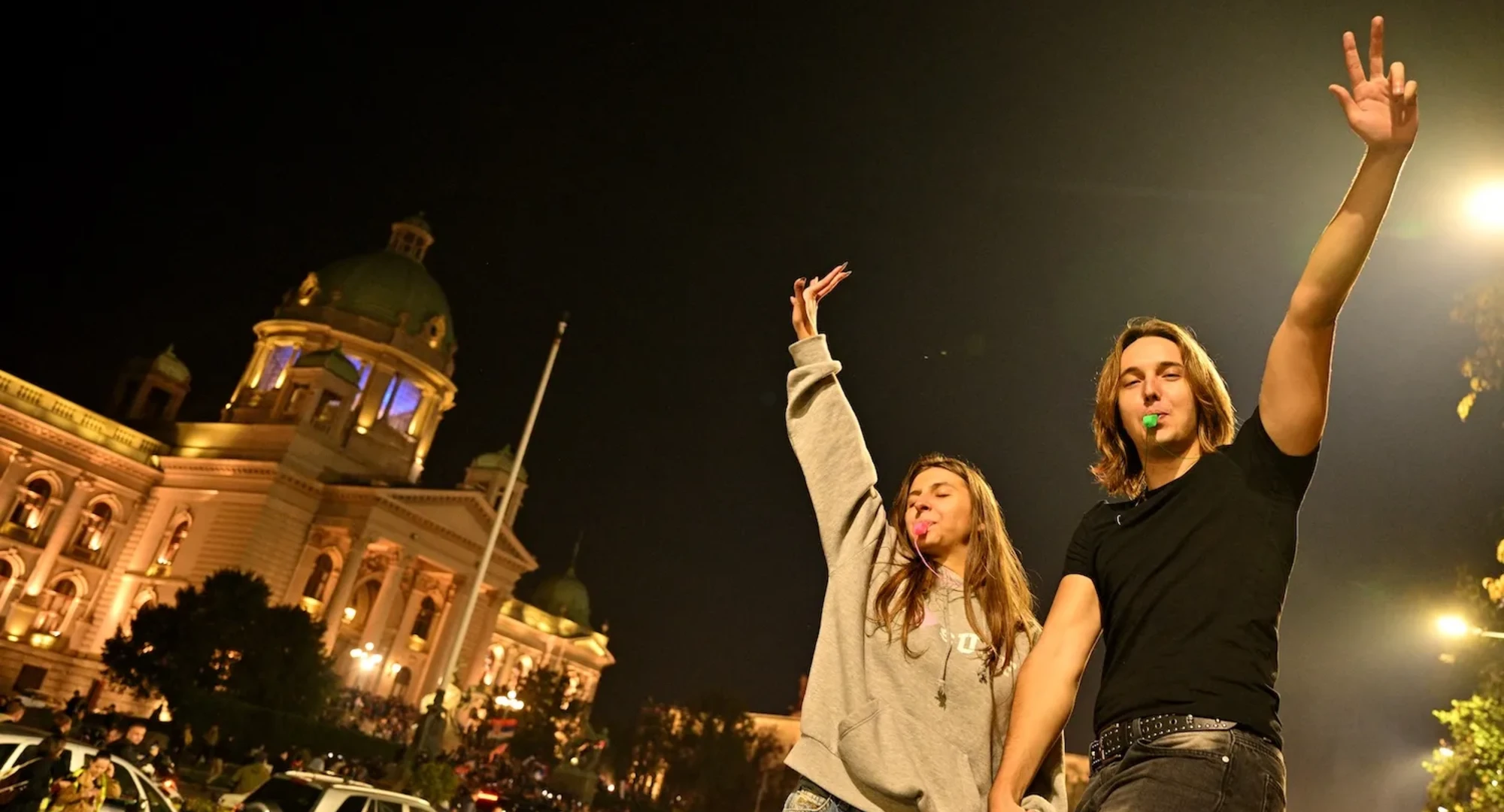
The next day, before the results were announced, cautious optimism and slight tension could still be felt. After the results were counted, when it became clear that the list supported by the students had won convincingly, and Vučić conceded defeat, the streets were instantly filled with shouts of joy and celebration. Amid the colourful smoke, people sang, embraced and danced. Sometimes people waved flags from the roofs of passing cars and shouted. At the same time, the Serbian public broadcaster RTS, on whose airwaves practically no one had previously heard a voice critical of the regime, apologised for the lies and falsehoods broadcast over the years. However, celebration aside, these events that same evening raised difficult questions: what would happen next, how would institutions be restored, and would the energy of the protests be able to transform into long-lasting democratic change?
I always wonder when that turning point arrives when everyone begins to act with a sense of responsibility. What logic is at work at such a time?
The day before leaving Belgrade, I went to the Tesla Museum. The guide shows us a short film and talks to us about Tesla's inventions. Then, in the adjacent hall, he takes us to one of his brilliant inventions—the Tesla coil. Tesla's experiment with high-frequency electrical oscillations and wireless transmission helped advance the scientific and technological foundations upon which radio communication and, eventually, modern wireless technologies would develop. The guide hands out long LED tubes. He warns us not to be afraid of what is about to happen. Then he turns on the large coil, which converts electricity into a current of extremely high voltage and high frequency. A blinding electrical spark flashes from the device. The LED lamps we are holding in our hands suddenly light up, despite the fact that they are not connected to any wires.
Suddenly, I realise that a logical connection exists between protest events and the Tesla coil as well. The coil does not create energy from nothing; it simply changes the conditions that allow energy to manifest itself.
Likewise, revolutionary imagination is not born from emptiness. It gathers people's accumulated frustrations, desires, memories, and hopes, and transforms them into a force capable of changing the visible world.
We Recommend

Theater born in protest | Muro Ekizashvili
03.04.2026