

It's time for Brazilian cinema | Salome Kikaleishvili
Brazilian society isn’t particularly pragmatic. Some societies will say, “This is what we have to do, and we will do it.” Brazil is more, like, “Oh, I don’t know, let’s just move on and let’s not talk about unpleasant things.” I’ve heard that in family circles. I’ve heard that from politicians, and I heard that from Bolsonaro. But he didn’t put it as nicely as I just did. He said, “Only dogs look for bones.”
- Director Kleber Mendonça Filho (Magazine “The New Yorker”)
When The New Yorker journalist asked where his latest film, The Secret Agent, originated, Kleber Mendonça Filho pointed to the main archive of the city of Recife, where he spent months while working on Pictures of Ghosts (2023). He would sit there, immersed in the city’s past transformed into digital material, searching for something to hold on to in stories frozen in time. That archive set me on the path toward “The Secret Agent,” he said.
History and the city of Recife occupy a central place in Mendonça Filho’s cinema. History - the subject he grew up hearing about constantly from his mother, a professional historian - forms the core of all his films. Recife, the northern Brazilian city where he was raised, with its urban structure and socio-political backdrop, gives his work its distinct character.
“Now is the time for Brazilian cinema,” Mendonça said - and perhaps he is right. Last year, another outstanding Brazilian film, I’m Still Here by Walter Salles, won several major awards at international film festivals, culminating in an Academy Award for Best International Feature Film. This year, Mendonça’s The Secret Agent took home four prizes in Cannes: Best Director, Best Actor, the FIPRESCI Prize (awarded by international film critics), and the AFCAE Prize (from the French Association of Art House Cinemas). It later went on to receive two Golden Globe awards - for Best Film and Best Actor. Now, all of Brazil is awaiting another Oscar moment: The Secret Agent has been nominated in four categories.
Cinema = Memory
For Mendonça, cinema is part of memory. To the stories he found in Recife’s archives, he added elements drawn from his own childhood memories, shaping - out of this collective and personal stream of memory - a hybrid of detective story, drama, horror, and comedy. In this phantasmagorical political thriller, everything is possible: alongside real events and human tragedies, there is room for a two-headed cat, and even for a single hairy human leg pulled from a shark’s stomach - an object the characters cannot get rid of throughout the film.
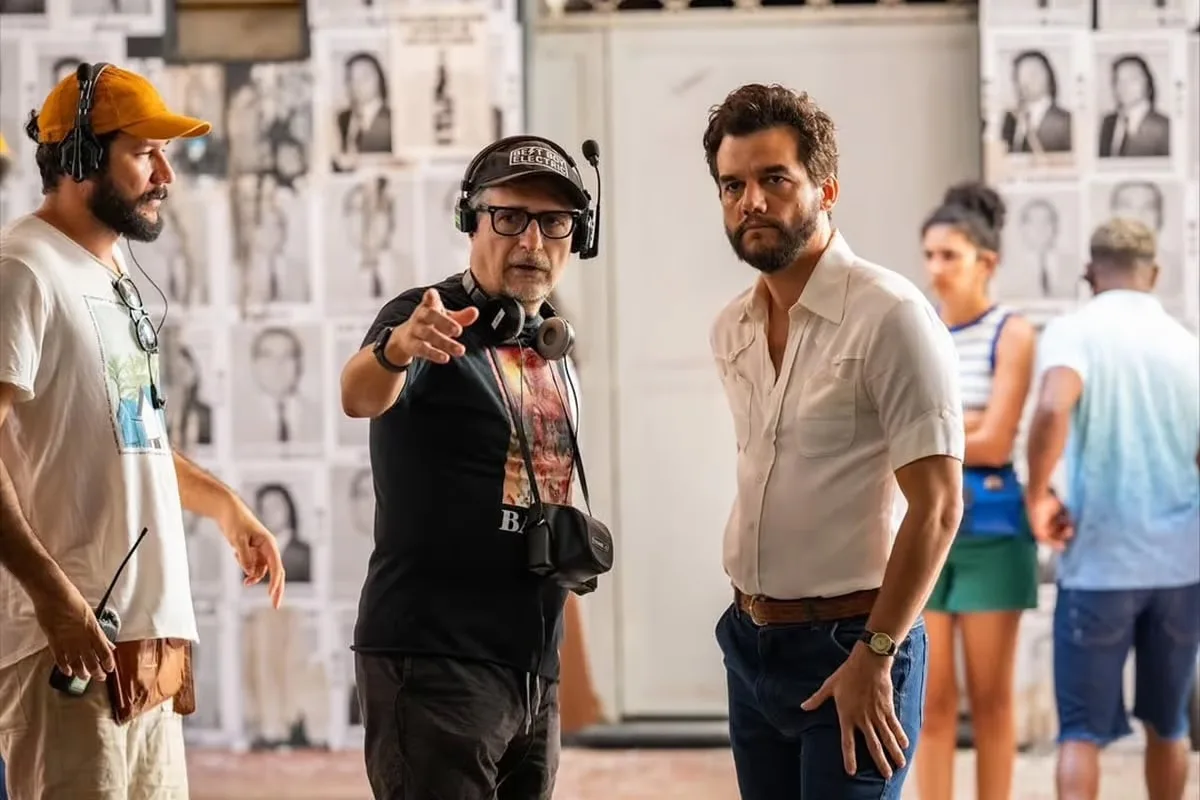 Kleber Mendoza Filho and Wagner Moura during the filming of "Secret Agent"
When he finished the script and shared it with friends, everyone was convinced it depicted contemporary Brazil. In fact, the film is set in 1977. The reason for this confusion lies in recent years - especially during Jair Bolsonaro’s presidency (2019-2023) - when the country seemed to slowly slide backwards, beginning to resemble Brazil between 1964 and 1985, a period when it was suffocating under dictatorship. It felt as though the tentacles of authoritarianism were still clinging to the territory. The government went after anyone and anything that did not align with ultra-right ideology. Culture and the arts were among the first targets, and all those who spoke out were declared enemies. Among them were the film’s director, Kleber Mendonça Filho, and the well-known Brazilian actor Wagner Moura, who plays the lead role in The Secret Agent. In one interview, Moura notes: “Authoritarians attack universities and artists first, in order to prevent them from telling history in ways that might harm the government.” Mendonça, for his part, recalls the Cannes premiere of his film Aquarius (2016), when a protest against the Brazilian government voiced on the red carpet was followed, back home, by the abolition of the Ministry of Culture - and by a major government-led boycott of his film.
What Is It About The Secret Agent?
The Secret Agent depicts the final phase of Brazil’s attempt to break free from a forty-year dictatorship. It was one of the darkest periods in the country’s recent history: lawlessness and crime flourished; human life was so devalued that hired killers would sell it for pennies and earn extra money in their spare time hauling sacks of sugar; the government and criminality shared the same bloated face; and catching sight of a police officer who was supposedly “guarding the truth” usually meant the beginning of serious trouble.
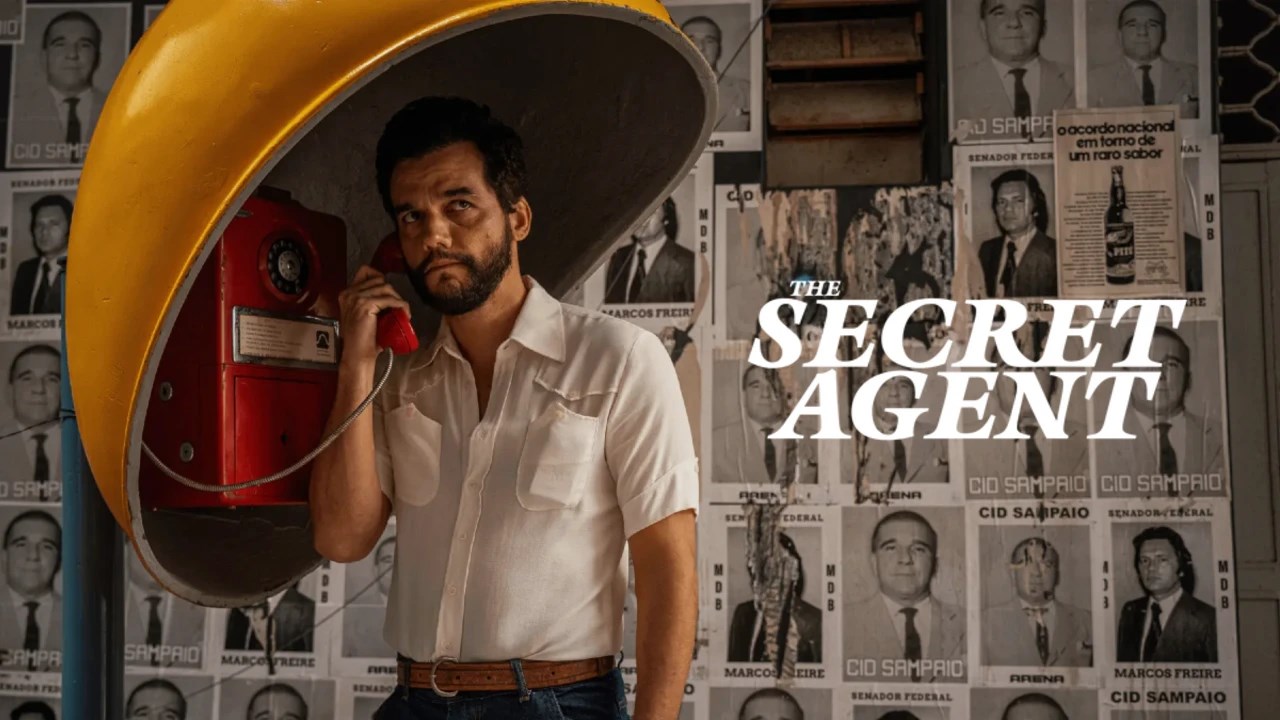
This is the world Mendonça leads us into, while also introducing Professor and researcher Armando Salimões (played by Wagner Moura), who returns to Recife in a yellow Volkswagen Beetle. After his wife’s death, the young man must take custody of his small child, who has been living with his grandparents; wait for forged passports to be prepared; and then flee the country without looking back. Ever since he crossed paths with a businessman closely connected to the government, his life has been turned upside down. Until all of this is resolved, he introduces himself to everyone as Marcelo Alves and rents a room in Dona Sebastiana’s house - a room inhabited by a two-headed cat.
In The Secret Agent, everything speaks to you: sound, visuals, color, texture, history, music, even the weather. The story, divided into chapters, gives you the space to observe every detail, inviting you to greedily take in a world that is at once irresistibly seductive and endlessly dangerous. Its characters are vividly drawn - thin and heavyset, tall and short, kind (they smile) and cruel (they sneer). The richly layered and diverse musical score sharpens the sense of Brazilian rhythms of the 1970s, pulling you even deeper into the era.
Wagner Moura truly deserved the Golden Globe for this role. His performance precisely conveys the story of Armando Salimões - a man who once had a life: a wife, a child, and meaningful work at a research institute. Armando is neither all-powerful nor fearless, and he is not an agent of any kind. He is another victim of Brazil’s military dictatorship, searching for a needle in a haystack - for justice in an unjust world, and for a way to survive. With the help of Dona Sebastiana, he begins working at an archive that issue’s identity documents and birth certificates. Throughout the nearly three-hour film, every time the archive building appears on screen, we see Armando searching through the archived files for his mother’s birth certificate. Even when a hired killer in flip-flops is waiting behind the counter, Armando continues to look for that birth certificate.
Above, I mentioned the two-headed cat and the hairy leg.
“I used to hear the story of the hairy leg a lot when I was a child, and I always wanted to use it in a film,” says Mendonça. It is connected to censorship: during the dictatorship, several journalists invented this fantastical metaphor in order to describe criminal actions carried out by the police. The caricature of the hairy leg became so popular that people began to believe it actually existed, and some even claimed they had seen the hairy leg in the street. “It is both wonderful and deeply problematic at the same time,” the director adds. In the 1980s, in Recife, some people would lock their doors with a key after 6 p.m., afraid that the hairy leg might attack them. In The Secret Agent, this folkloric metaphor turns into a symbol of resistance - a resistance that, no matter how hard the system fights it, cannot be destroyed. Like a boomerang, it always comes back.
In December, I had the opportunity to speak with Mendonça. Naturally, the first things I asked him about this strange metaphor and the Brazil of his childhood.
“Brazil is in a much better place now, but in general this tendency toward dictatorship and autocracy is appearing everywhere,” Mendonça tells me. “In the United States, in some European countries, and in Georgia as well, as you say. Living under autocracy showed me that there are always people who refuse to accept reality and choose to fight it. This struggle is both tragic and comic at the same time - though more often than not, it is tragic.
For example, just two days ago in Brazil they arrested a guy - a complete idiot. During the Bolsonaro years, he was the head of national road police. On election day, he instructed his people to stop everyone wearing red shirts - which signaled support for Lula (Bolsonaro’s opponent and now Brazil’s president) - to ask them for documents and basically, you know, impounding their cars so that they would, fight reality and not allow people to vote in a completely ridiculous way.
So, I think when I wrote The Secret Agent, I was always paying attention to the moments when people were trying to fight reality, and using power. And unfortunately, this is something that has not gone out of style.”
He tells me that although his film is not a comedy, humor plays a very important role in this equation, because many such people confront reality with violence, arrogance, and stupidity.
Finally, when I ask him about the significance of cinema, he answers without hesitation: “To be honest, I don’t think films carry messages. But one thing I do know is that, along with books, films are capable of revealing the absurdity of life.”
As for absurdity.
Tânia Maria is a 78-year-old woman - small, hunched, with a hooked nose, thin lips, and oversized, thick-framed glasses. She spent her entire life in the north of Brazil, in an almost deserted village. Mendonça’s casting director discovered her quite by chance back in 2019, during the shooting of Bacurau, and cast her in the film. She was invited again for The Secret Agent, only this time she was given a more substantial role - that of Dona Sebastiana, the owner of the two-headed cat: dressed in a colorful cotton dress, her face hidden behind large sunglasses, simple summer slippers on her feet, and a constantly lit cigarette in her hand. After The Secret Agent was released, she became unexpectedly popular, and many people grew interested in her story. She says she lived her whole life on a farm with her family and spent most of her time sewing; that she saw a film in a movie theater for the first time at the age of 72; that she smoked for more than sixty years - three packs a day - and because of that she couldn’t attend The Secret Agent’s Cannes premiere: “How could I sit on a plane for that long?” she says. But then she adds that she finally quit smoking - because she wasn’t going to miss the Oscars. And when a journalist asks her about the plot of The Secret Agent and the dictatorship, 78-year-old Tânia Maria answers: “What can I tell you? On the farm where I spent my whole life, we had just one radio, and no one ever talked about the dictatorship there. I had no idea such things were happening in our country.”
That’s where I should talk about the birth certificate.
Why does Armando desperately search for his mother’s birth certificate? The answer comes at the end of the film. Armando, a victim of the system, could one day disappear in exactly the same way his mother did - as if he had never existed at all. That is why he clings so fiercely to her birth certificate: as a fact, as proof that yes, she truly existed - just like all those victims of oppression, injustice, evil, and dictatorship whom history erased without looking back.
The film ends in contemporary Brazil. We see two students listening to audio recordings of victims from the time of the dictatorship. All that remains of Armando is his voice. One of them, Flávia, decides to travel to Recife to bring the recording to Armando’s now-grown son. “I don’t remember my father,” replies Fernando, now a doctor. Flávia places a tiny memory card on the table. Armando - a voice from the past, heard in the future.
Alongside memory, this film is about all those lost generations who, together with their parents, lost a large part of their own identity and then spent their entire lives trying to fill that void.
P.S. I’m still listening to The Secret Agent’s album on loop on SoundCloud. If Southern music appeals to you too, I highly recommend it.
We Recommend