

Studēre, or the Striving for Learning | Mariam Shergelashvili
21.10.2026 | 6 Min to readSeveral Aspects of Contemporary Art Education: Critical Pedagogy and Collaborative Forms
(Through the Example of Ernest A. Bryant III’s Experience in Tbilisi)
“The teacher is not the one who transfers knowledge, but the one who helps
another person use their own intelligence.”
(translated by the author of the article)
- Jacques Rancière, The Ignorant Schoolmaster (Le Maître ignorant, 1987)
How is knowledge produced? This question can be considered one of the central challenges of contemporary art education. Knowledge is still often understood as a resource possessed by one individual and transferred to another. Within this model, teaching is regarded as a process of transmitting information. However, over the past decades, an increasing number of educational and cultural practices have proposed a different perspective. Knowledge can emerge through collaboration, collective work, observation, critical dialogue, and the sharing of experience.
This issue is particularly significant in art education. Teaching art cannot be limited solely to the development of technical skills or the study of art history. It also involves the formation of relationships, critical thinking, and professional responsibility.
An important opportunity to reflect on these questions is provided by the artistic practice of the American interdisciplinary artist and educator Ernest A. Bryant III, carried out in Tbilisi during his 2025–2026 academic sabbatical from New York University, Gallatin School of Individualized Study. The various projects developed, including exhibitions, discussion programs, public events, and collaborations with students and cultural institutions, are significant as independent cultural initiatives. These activities allow us to observe how teaching can become part of a collective practice; how the roles of teacher and student evolve within this process; and how space, dialogue, and shared responsibility acquire central importance.
This article does not attempt to provide a comprehensive account of the projects themselves. Instead, it reflects on those aspects of Bryant’s creative and pedagogical practice that intersect with contemporary approaches to art education. Through this perspective, it becomes possible to discuss broader issues, particularly the relationship between criticism and educational methodology. I believe these questions are especially important within the Georgian art scene and its wider cultural context, which continues to experience fragmented, isolated, and structurally closed conditions, particularly against the backdrop of the broader social and political crisis in which the country itself is operating.
Criticism + Value
Within art education, criticism is often associated with evaluation. It is commonly understood as a tool through which the quality of an artwork, the author's position, or its theoretical significance is assessed. In this model, critical writing usually appears at the end of the creative process. Critical commentary functions as a concluding act, produced only after the completion of the artwork or the exhibition. Contemporary artistic practice, however, increasingly proposes a different approach. Criticism is not serving as a final evaluative statement, it becomes an open dialogue - a process of exchange and collective thinking. In this context, critical writing becomes an active participant in the creative process itself.
This approach is clearly reflected in Criticism + Value, the platform founded by Ernest A. Bryant III in 2020. The project began during the pandemic as a series of online lectures, but gradually developed into a multidisciplinary educational initiative incorporating performative essays, public conversations, collective reading sessions, discussions, and collaborations between practitioners from different disciplines. For me, one of the platform's most important functions lies in returning criticism to the realm of living dialogue, recalling one of the central principles of ancient philosophy, where thinking and reasoning emerged through conversation.
One of the central formats of Criticism + Value is the performative essay. Through this format, Bryant reactivates the perspectives of historically significant artists, writers, thinkers, or even works of art themselves. Using augmented reality, role-play and performative, ritual-like methods, he reads texts written from their imagined viewpoints. Through this approach, participants temporarily shift their own perspective and way of perceiving both the artwork and its historical context. The performative essay allows us to step outside our own interpretative framework and consider an artist or artwork from another position.
Another important characteristic of this practice is participation. Every public reading concludes with an open discussion. The audience is not treated as a passive recipient of the text but gradually becomes an active participant in its interpretation. In this process, critical thinking is transformed from an individual intellectual activity into a shared intellectual practice.
Such an approach closely reflects the idea of emancipatory education proposed by the French philosopher Jacques Rancière. Rancière argues that intellectual equality should be understood as the starting point of education. Teaching begins when the teacher no longer regards their own knowledge as the sole authority and instead transforms the educational process into a shared act of inquiry.
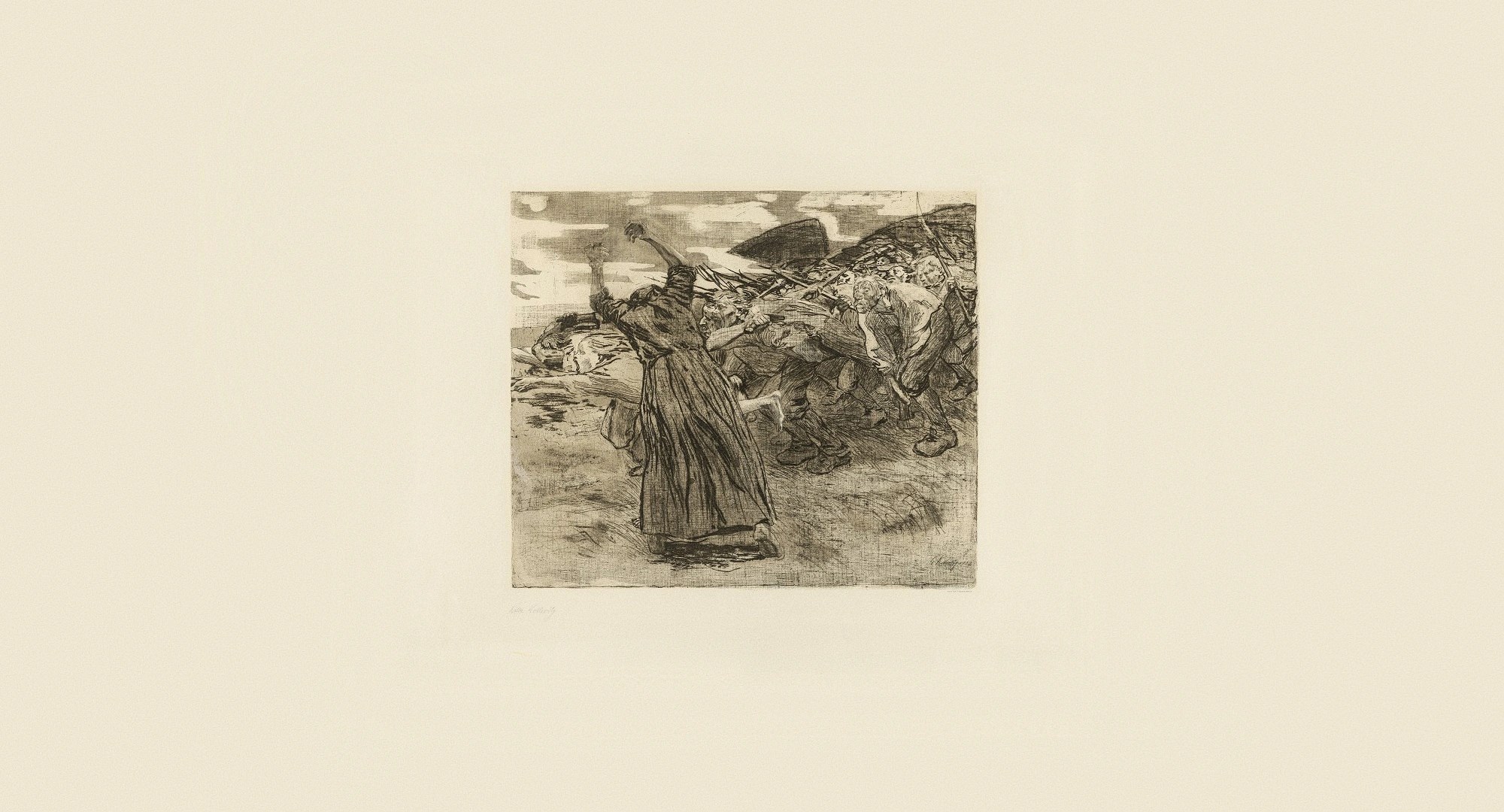
I believe that the greatest value of Bryant's pedagogical practice lies in his ability to create an environment where different experiences come together and meaning emerges through collective discussion. This approach was clearly demonstrated in the exhibition Käthe Kollwitz: The Powerless in the Mist of the Juggernaut, curated by Bryant and presented in collaboration with TIMM Architecture in Tbilisi. The exhibition brought together original graphic works by Käthe Kollwitz, pedagogical research, and studio-based practice within a single curatorial framework.
Kollwitz's graphic works occupy a significant place in both art history and social history. Created at the turn of the nineteenth and twentieth centuries, they address questions of human dignity, labour, poverty, and violence. Her visual language combines empathy with civic responsibility, making these works remarkably relevant today, as they continue to raise urgent questions concerning social inequality, justice, compassion, and human dignity.
Beyond presenting Kollwitz's original works in Tbilisi for the first time, the significance of the exhibition also lay in the way it was produced. The exhibition was developed through the direct participation of young students. Since February 2026, Bryant served as a visiting professor at the Tbilisi State Academy of Arts, where he led a sixteen -week academic course. Within this course, Kollwitz's graphic works, which form part of Bryant's personal "educational collection" became subjects of practical observation, research, and critical reflection for the students. Daily work in both the studio and the exhibition environment provided participants with valuable experience while clearly demonstrating one essential principle: critical thinking develops through process. It emerges when individuals deepen their own perspectives through careful observation, continuously question their assumptions, listen to the views of others, and naturally embrace multiple interpretations.
In this sense, criticism develops through relationships between people, through close observation of artworks, and through direct engagement with them. From this perspective, I believe that Käthe Kollwitz represents a particularly meaningful choice, especially within today's climate of social and political crisis, where inequality and injustice have become increasingly visible. It is precisely through such experiences that education moves beyond the transmission of knowledge and becomes a shared practice of understanding and responsibility.
Equally important is the long-term impact of this process on the local artistic environment. Criticism + Value will continue its activities beyond the temporary exhibition format at TIMM Architecture, establishing its first permanent physical space. This marks an important new stage in the platform's development, while also creating opportunities for alternative curatorial initiatives and experimental educational practices within the local cultural context.
Within contemporary art education, learning has long extended beyond the classroom into shared working processes, everyday practice, and the creation of common environments. Knowledge cannot be understood solely through formal curricula or institutional structures. Instead, the continuous support of independent initiatives, the encouragement of self-organized systems, and their recognition as an integral part of institutional and structural approaches become essential. This represents a flexible model of collaboration, a network of interconnected relationships in which collective engagement forms the foundation of learning. In this context, the space where creative exchange and shared practice take place is not merely a physical setting, but an active participant in the educational process itself.
From this perspective, another important initiative developed during Bryant’s time in Tbilisi was Woven Together, a student collective and educational project that brought together participants from the Tbilisi State Academy of Arts through a collective open-studio format. The project combined theoretical discussion and studio practice with practical experience related to exhibition-making. Students worked with readings in aesthetic theory, philosophy, and social and political thought alongside artworks introduced within the course, while also becoming involved in writing artist and curatorial statements, preparing the exhibition space, and developing the visual presentation of the event.
Importantly, Bryant approached the open studio as an extension of the educational process itself, with an emphasis on ongoing work and experimentation. As he explains, the format was intended to allow students to share what they were working on and receive feedback from peers and the public “without the pressure of having to mount a full scale exhibition.” The open studio made research, material investigation, and creative experimentation visible as processes in their own right. In this sense, the public was invited to gain a temporary glimpse into the working classroom and the students’ developing ideas.
Today, within the local context, Shardeni Street is largely associated with urban chaos, gentrified touristic zones, and the gradual loss of authenticity. Yet hidden within this fragmented urban landscape is a space that often goes unnoticed. Founded in 1998 by professors and artists Givi Kandareli and Tamaz Nutsubidze, the Tapestry and Textile Art Museum belongs to the Tbilisi State Academy of Arts and preserves a permanent collection of artistic textiles. Although the museum periodically hosts exhibitions and cultural events, it remains relatively unknown beyond specialists in the field, receiving little attention from local residents and the wider public. Against this background, encouraging students to step outside their familiar educational environment and engage with a new space became one of the project's main objectives.
The collaboration with the museum developed gradually. Bryant's Criticism + Value lecture series was held in the museum's temporary exhibition space. At the same time, another part of the museum was occupied by students from the Textile Department under the supervision of textile artist Nino Kvirivishvili. Through the shared interests and collaborative efforts of these two groups and their respective educators Kvirivishvili and Bryant, the exhibition Woven Together gradually emerged. The processes of teaching, research, and exhibition-making became a single integrated practice, bringing together different experiences in a natural way. Most importantly, students themselves played a direct role in organizing the space, preparing the exhibition, installing the display, and managing all of the logistical and conceptual components necessary for its realization.
Returning to Richard Sennett, he describes cooperation as a skill that cannot be acquired through theoretical knowledge alone. It requires everyday interaction, careful listening, and the experience of working alongside different perspectives. For this reason, collaboration should be understood not simply as an organizational principle but as a culture that can only be learned through practice. Embracing these principles, Woven Together moved beyond the format of a one-time group exhibition. The participating students subsequently established an independent collective, Woven Together Collective, which has already organized several public presentations. The collective plans to develop further exhibitions and educational programs within the same space, offering the possibility that this collaborative rhythm will continue over the long term while welcoming other independent initiatives.
Equally important is the everyday work that emerged through this collective effort - from preparing the exhibition and organizing the space to informal meetings and critical discussions. Through these shared experiences, young participants gradually develop their own perspectives, cultivate independent approaches, and establish long-term models of collaboration. In this way, the educational process shifts from a temporary academic activity to an ongoing daily practice, while the museum itself becomes activated through the presence of an independent student-led platform.
The same long-term and collaborative approach is reflected in another independent initiative led by Ernest A. Bryant III. Developed in collaboration with the Domestic and Care Workers' Union, the project consisted of an eight-week printmaking course. Its primary aim was to make visual literacy and creative practice accessible to individuals who do not have access to formal art education. The program was developed through dialogue with union members and approached art as a means of shared experience, labour, social visibility, and collective expression.
Throughout the course, participants learned linocut and printmaking techniques. However, the emphasis was placed not on technical skills alone, but on developing visual thinking, critical observation, and an understanding of the social significance of images. As with Bryant's other projects, the central objective was the creation of a sustainable model developed in close collaboration with the participants themselves. Rather than offering isolated workshops or focusing solely on individual skill development, the initiative sought to establish a collaborative creative structure, from constructing a printing press to mastering printmaking techniques. In the long term, the project envisions the development of a printmaking residency program involving invited artists, while strengthening domestic workers' professional networks and fostering lasting collaboration with the union.
The initiatives discussed above - Criticism + Value, Woven Together, and the printmaking course, ZRUNVA, developed with care workers, all share the same pedagogical principle. By bringing together people with different experiences within a common process, art is transformed from a medium for transmitting knowledge into a practice of shared social responsibility, creative participation, collaboration, and critical reflection.
Educational institutions, universities, and the broader education sector are facing increasingly complex challenges. In this context, independently driven approaches to renewal become particularly important, approaches that emerge from within and move outward, supporting and strengthening student-led, youth-driven, and independent perspectives. Over the years, informal educational spaces and self-organized creative initiatives in Tbilisi have played a significant role in creating platforms for learning, experimentation, and exchange. As systemic instability, isolation, and various forms of crisis continue to intensify, the integration of informal and experimental approaches, including within universities, appears to be an essential condition for renewal. At the same time, it is important that such initiatives develop through a long-term, open, and collaborative vision. One of the most persistent challenges remains the sustainable development of creative approaches and collectives, as well as the transformation of time-limited, project-based activities into lasting structures and practices.
Another persistent challenge is the widespread perception that creative thinking belongs primarily to a romanticized or bohemian lifestyle. This stereotype requires fundamental reconsideration. In this process, education remains indispensable. The everyday work carried out through artistic education demonstrates that studying art is far more than learning methods of composition or acquiring technical skills. Above all, it is about enabling students to develop adaptive, discursive, and analytical ways of thinking within today's complex realities; to cultivate critical reflection; to establish collaborative models with both institutions and independent collectives; and ultimately to integrate the social role of the artist more deeply into public life.
Open collaborative models that understand criticism as a productive process directed toward meaningful change may be imagined, symbolically, as a woven tapestry. Within this fabric, every element such as institutions, artists, and independent platforms contributes through collective effort to repairing the gaps that have gradually become fundamental fractures within our society. In this process, the energy of younger generations and the development of a healthy, collaboration-based culture of constructive competition become the driving force capable of producing genuine transformation and long-term progress.
Author: Mariam Shergelashvili, M.A. Art History and Theory, independent researcher and curator
References
Paulo Freire, Pedagogy of the Oppressed (1970). Freire develops a dialogical model of education as an alternative to the conventional model of knowledge transmission.
Jacques Rancière, The Ignorant Schoolmaster (1987). Rancière examines the principles of knowledge and intellectual equality from a socio-political perspective.
Grant Kester, Conversation Pieces: Community and Communication in Modern Art (2004). Kester argues that in contemporary participatory art, dialogue is no longer merely a means of interpreting the artwork but becomes an essential component of the creative process itself.
Richard Sennett, Together: The Rituals, Pleasures and Politics of Cooperation (New Haven: Yale University Press, 2012). Sennett understands cooperation as a social skill that develops not only through shared goals or formal instruction, but through continuous practice and interaction.
We Recommend
Pupil's book
02.10.2023