

Beyond National Passions and Geopolitical Imperatives | Conversation with Timothy Blauvelt
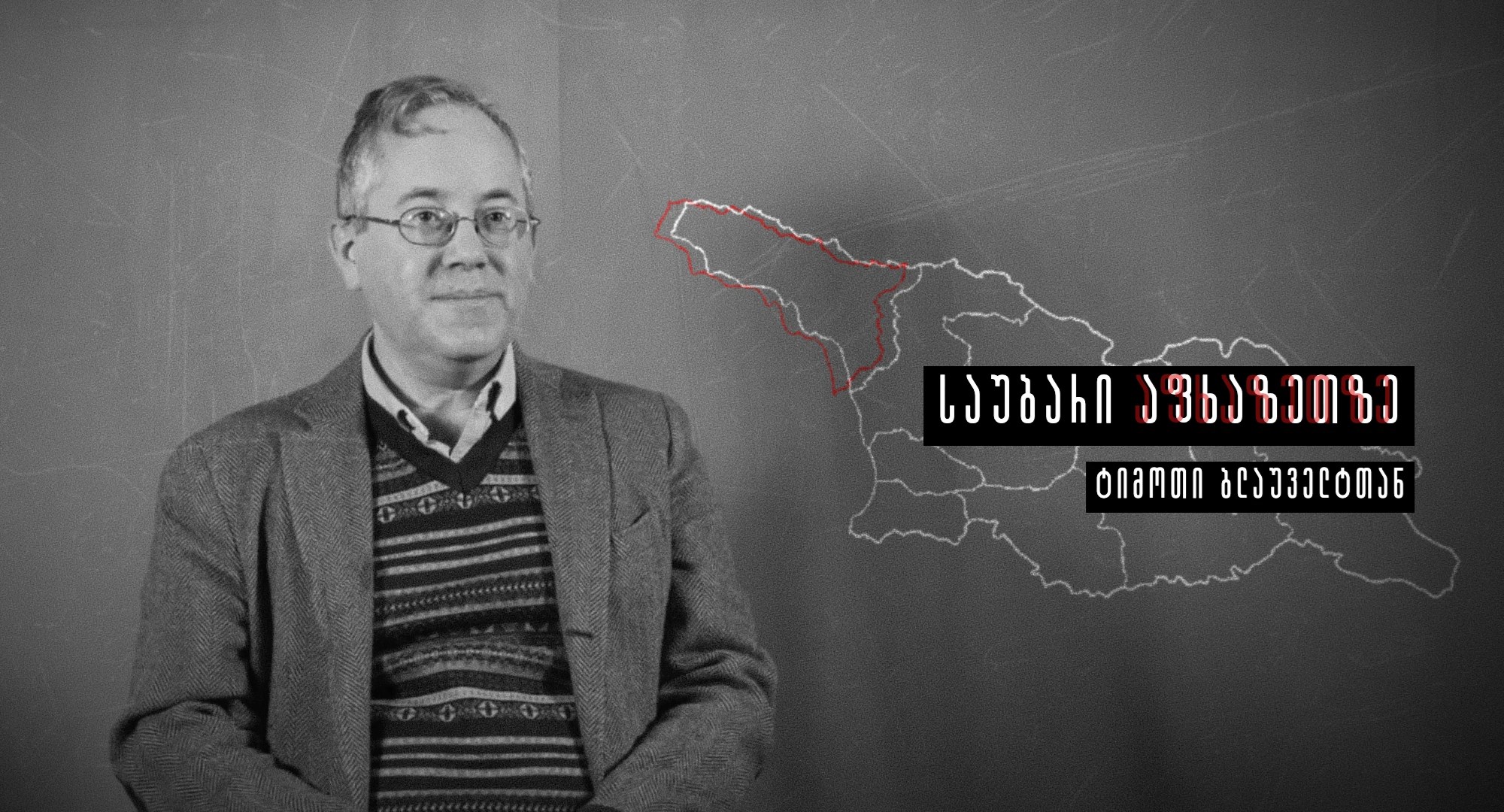
17.07.2026 | 15 Min to readTimothy K. Blauvelt has been researching Soviet and Post-Soviet space for many years. After teaching at Ilia State University in Tbilisi, Georgia, and after serving as the Regional Director for the South Caucasus for American Councils for International Education, he currently holds a position of the Research Professor of Russia and Eurasia Studies at the U.S. Army War College. As he reflected during our conversation, his path to Georgia was somewhat indirect. While participating in study abroad programs in Russia during the First Chechen War in the mid-1990s, he became fascinated by the "peripheries" of the former Soviet Union. However, his initial plan to conduct dissertation research in the North Caucasus was thwarted by the outbreak of the Second Chechen War.
Even before arriving in Georgia, Timothy studied the Georgian language at Indiana University under Dodona Kiziria, Associate Professor Emerita in the Department of Slavic and East European Languages and Cultures. These classes—and Kiziria’s profound political insights—further solidified his interest in the region. Consequently, he shifted his focus as a political science student toward contemporary Georgian nationalism. He first came to Georgia in September 1999 to January 2000 to conduct a search for his dissertation. After returning and defending this in 2001, in 2002 he moved to Georgia as a Fulbright scholar and, as he notes, "really, I've been here ever since." A pioneer in archival research, Blauvelt began his work even before the presidential decree officially opened the Communist Party archives, where he uncovered a wealth of documentation regarding Abkhazia and Nestor Lakoba – “the unquestioned boss of this tiny republic on the Black Sea coast of the USSR, of this vacation retreat for Communist Party leaders and of this major producer of tobacco. Blauvelt extensively researched the story of early Soviet Abkhazia and reconstructed ways of building “a powerful local ethnic ‘machine’, that became an influential component of Soviet patronage politics, provoking along the way accusations of nepotism, corruption, blood feuds, embezzlement, racketeering, and extrajudicial murder on a scale that shocked even hardened Communist Party investigators. Lakoba and his group faced a series of hearings, investigatory commissions, and tribunals over allegations of malfeasance, yet they were repeatedly able to convince their powerful patrons of their irreplaceability until at last they were destroyed through a public show trial during the peak of the Stalinist Terror. Through the prism of tiny Abkhazia, this book provides invaluable insights into the nature of the early Soviet system and the governance of Soviet national republics.” (the topic description is the citation from the website of the Masters Program in Modern History of Georgia of Ilia State University).
Professor Blauvelt is the author of Clientelism and Nationality in an Early Soviet Fiefdom: The Trials of Nestor Lakoba (Routledge, 2021), for which a Georgian translation was released by Ziari in 2023. He is also the co-editor, with Jeremy Smith, of Georgia after Stalin: Nationalism and Soviet Power (Routledge, 2016), and, with Adrian Brisku, of The Transcaucasian Democratic Federative Republic of 1918: Federal Aspirations, Geopolitics, and National Projects (Routledge, 2021). A Georgian edition of the latter was subsequently published by Ziari Press in 2023.
Tamar Babuadze: After years of research into the region’s diverse history, you focused your book on Nestor Lakoba as the lens through which to explore Abkhazia. One could argue that Lakoba is central to the 'logic' of Abkhazian identity and its historical challenges—was this what motivated you to bring his story to the forefront for a broader audience? While the book offers rich historical analysis and nuanced descriptions, it remains highly accessible for anyone interested in the 'Abkhazian topic'.
Timothy Blauvelt: Probably we'll discuss Stanislav Lakoba today, the Abkhaz historian who died in September 2025 in a car crash. He is the author of an article called Ia Koba, a Ti Lakoba (Я – КОБА, А ТЫ – ЛАКОБА), about the relationship between Stalin and Lakoba, and that was a really interesting article. Because he published that story in many different forms over the years, I wanted to write something that returned to the primary archival sources he used for his research.
For instance, what made Abkhazia unique within the Soviet system? In the first place, it was a subtropical place—often called the 'Soviet Florida' or the 'Soviet Riviera.' After the swamps were drained in the early 20th century, a region once uninhabitable due to malaria was transformed into a vital producer of high-demand citrus and tobacco – things which were unique in the Soviet system, or almost unique.
Then Abkhazia was distinguished by its sanatoria. This system was originally developed in the Tsarist era as a domestic alternative to the South of France for Russian nobles. So in addition to becoming a center of investment in tobacco plantations, Abkhazia was an exotic place where you could build your dacha, a resort… Later it became the premier destination for the Soviet elite. Archival documents reveal a constant scramble for assignments there. Even the Politburo was frequently sent to Abkhazia for health reasons. A pivotal example is Leon Trotsky, who was sent to Abkhazia while ill. Archival records—including messages from Sergo Ordzhonikidze and Felix Dzerzhinsky—detail instructions to Lakoba to 'keep the guest entertained.' This ties into a crucial moment in Soviet history: during the interregnum as Lenin’s health declined and the struggle for succession began, Trotsky was in Sukhumi. When Lenin died, Stalin famously misled Trotsky about the funeral date, claiming he wouldn't arrive in time even if he left immediately. This ruse (because the funeral was actually happening on Sunday) ensured Trotsky was absent from the funeral, costing him the prestige and authority necessary to challenge Stalin for power.
Historian E.H. Carr uses this specific incident in his book What Is History? to illustrate the concept of historical contingency. In the chapter 'Cleopatra’s Nose'—referring to the idea that if Cleopatra’s nose had been different, Marc Antony might not have become infatuated with her, so history might have changed—Carr notes that Trotsky catching the flu while duck-hunting in Abkhazia altered the course of the Soviet Union. This leads to the essential question: Why Lakoba?
Beyond the official Party archives, there is a collection of Nestor Lakoba’s personal papers. Although small—roughly a thousand pages—these files are vital for understanding Soviet history in the 1920s and '30s. They eventually ended up at the Hoover Institution at Stanford University, but their journey there is a story in itself.
Nestor Lakoba died under highly suspicious circumstances in 1936. After being summoned to lunch with Lavrentiy Beria in Tbilisi, where they reportedly ate fish at Beria’s house before attending the opera, Lakoba fell ill at the theater and died later that night. Legend has it that Nestor Lakoba’s wife, Saria, then burned a portion of his archive in their yard to mislead the authorities, while secretly burying the rest in a metal box beneath their floorboards. In the mid-1950s, Nestor’s brother-in-law returned from the Gulag and recovered the papers from workers who had discovered them during renovations. Apparently, Stanislav Lakoba was able to view them in 1990 before they were eventually sold and moved to Stanford, where I have since studied them.
This collection contains numerous draft letters from Lakoba and correspondence from Beria dating back to the 1920s. These documents are essential for tracing the burgeoning relationship between Beria and Lakoba—a central theme of Stanislav’s research. His objective was to demonstrate the importance of Nestor Lakoba and of Abkhazia and how they served as the primary channel through which Stalin first became acquainted with Beria. Without this link, how Beria originally entered Stalin’s inner circle remains kind of a historical mystery.
INDIGO: It’s easy to get drawn into your narration of the past; let's just follow that flow. So, Stanislav Lakoba argues that Nestor Lakoba was the one who facilitated the introduction between Stalin and Beria—is that correct?
T.B.: That's really the point of his article – that the crux of Stanislav Lakoba’s argument is that the meeting between Stalin and Beria likely would not have occurred without Lakoba’s mediation. Even though this seems unlikely, Lakoba clearly was important in the Stalin-Beria meeting, because Lakoba controlled Abkhazia—a subtropical hub where the Soviet elite gathered, and he held immense political capital. From the mid-1920s through the mid-30s, Stalin spent months every summer at his dachas in Abkhazia or further north, in Adler or in Sochi. In this environment, proximity meant power; it provided Lakoba with the essential ‘facetime’ that allowed him to consolidate his network.These documents illustrate that the relationship between Beria and Lakoba was, at least initially, one of mutual benefit.
My interest in Abkhazia extended beyond Lakoba to the broader mechanics of patronage and clientelism. He was part of this larger interest. A vital source for this is the memoir of Akaki Mgeladze, the former Georgian Party Chief, published in Tbilisi by the Mgeladze family in 2001. Dictated to his wife and published in Russian, the book recounts how Stalin personally appointed him as the First Party Secretary in Abkhazia in 1943. At the time, the Red Army 'ran on tobacco,' and Abkhazia was a primary producer. Stalin needed someone reliable to manage this critical resource, and through this appointment, Mgeladze became a direct 'client' of Stalin.
This is particularly significant because it addresses a long-standing debate in the Kremlinological literature: whether Stalin maintained direct personal clients. I believe he did. Mgeladze belongs to a specific group of 'Stalin’s men'—including Leonid Melnikov in Ukraine—whom Stalin promoted in the peripheries to ensure absolute loyalty. Mgeladze’s memoirs vividly demonstrate how these patronage networks functioned. He describes walking along the embankment with Stalin, proposing an idea, and receiving immediate approval. These informal interactions show that a region’s importance was often tied to its accessibility to the leader and the personal loyalty of its administrators.
INDIGO: So, when considering Abkhazia’s unique significance within the Soviet system, should we view it as a convergence of these overlapping factors—its economic resources, its role as an elite resort, and these informal patronage networks?
T.B.: Exactly. Abkhazia’s unique economic and political assets provided immense political capital, making it exceptionally valuable despite its small size. This explained why access to the region was so fiercely contested. My 2007 article in Nationalities Papers, 'Abkhazia: Patronage and Power in the Stalin Period,' explored how these regional patronage advantages functioned within the broader structures of Soviet history.
My subsequent research into the 1920s and '30s focused on nationalities policy and linguistic korenizatsia (indigenization). As Claire Kaiser argues in her work, the early Soviet regime attempted to 'depoliticize' nationalism by granting ethnic groups the outward forms of nationhood—such as native-language education and alphabets—alongside affirmative action for 'titular' nationalities.
One of Kaiser’s key contributions is the concept of 'entitled nations.' Rather than using the binary of 'titular' vs. 'non-titular,' which doesn't account for the actual degree of privilege, she focuses on 'entitlement.' In the upcoming Russian translation of my book, we decided to use the term tituliarnaia natsia rather than the standard titulnaia to better capture this nuance of state-granted privilege.
Indigo: Let’s explain the difference a bit more.
T.B.: The term 'entitled' implies a deliberate selection by the state. To be entitled was to be granted specific privileges—rights to territory, language, and administrative preference—through a policy of positive discrimination. Abkhazia serves as a good case study for how these hierarchies shifted over time. During the period of 'High Stalinism' (late 1930s to the 1950s), both Abkhazians and Georgians were 'entitled' in their respective spheres: the Abkhazians within their Autonomous Republic and the Georgians within the broader Georgian SSR. However, within this structure, the Georgians were clearly the more 'entitled' group. This policy was rooted in a pragmatic realization: since nationalism was not going to vanish as a good Marxist would hope, the state required an interim strategy. By granting these concessions and privileges, the regime hoped to manage national identity until it eventually withered away.
What is particularly fascinating is how this formal approach overlapped with informal clientelism. As seen with the appointment of Mgeladze, Stalin continued to rely on personal patronage networks even as policy evolved. Nationalities policy underwent a significant transition: from the 'ethnophilia' stage of the 1920s—where even the smallest ethnic groups were granted status and privileges—to the 'Great Turn' of the 1930s, which prioritized larger nationalities. This shift also redefined the state's perception of threat. In the 1920s, the 'greater danger' was identified as Great Russian Chauvinism, while the local nationalism of small nations was a ‘lesser danger’; however, by the 1930s, the focus shifted toward suppressing local nationalisms.
INDIGO: There are references in the archives about discussions of the Great Russian Chauvinism and about the Russians being a greater danger?
T.B.: The published transcripts of the Party Congresses, particularly the 12th Party Congress in 1923, illustrate this clearly. Drawing on Lenin’s legacy, the leadership addressed what he termed Velikorusskiy shovinizm (Great Russian Chauvinism). Lenin argued that this was the primary threat to the Soviet project; because the peoples of the former Empire had been oppressed under Tsarism, Russian chauvinism was the 'greater danger.'
To neutralize this, the state offered concessions to local nationalisms, which were viewed as the 'lesser danger.' By granting these concessions, the Bolsheviks hoped to win the loyalty of the people in the peripheries. However, this approach was not without its detractors within the Party. Figures like Nikolai Bukharin expressed concern, arguing that by granting territory and institutionalizing culture through positive discrimination, the state was inadvertently encouraging the very nationalism it sought to eventually dissolve.
INDIGO: Following that logic, you highlight archival evidence of leadership discussing 'Georgian Chauvinism' as a threat. Was this seen as a specific iteration of the 'lesser danger,' or did it represent a different kind of political challenge in the Caucasus?
T.B. The consensus in the 1920s was that these concessions were merely a transitional phase. However, by defining territories along national lines and determining resource allocation based on ethnic categories, the state inadvertently ensured those identities would endure. Political scientists often stress that politics is fundamentally about who receives what and why; when 'what you get' depends on your category, that category becomes central to your life whatever they are. This is the long-term paradox of Soviet nationality policy: rather than allowing national identity to wither away, the system institutionalized and reinforced it. In that sense, Bukharin’s warnings proved right.
INDIGO: You think they truly believed that national identity will someday become irrelevant?
T.B.: I believe they truly did, and that conviction is reflected throughout the documents. They treated nationalism and ethnic animosities as perezhitki proshlogo—'remnants of the past'—that were destined to be outlived like an anachronism. As I mention in the book’s epilogue, while it is difficult to quantify, there was a palpable sense of resentment from the broader Georgian Party apparatus regarding Lakoba and the specific privileges afforded to Abkhazia. Something directly chauvinistic indeed was omitted from the transcripts, newspapers reports or any other the archival documents, but the annoyance of the larger Georgian Party cadres and the members of the central committee at Lakoba and privileges for Abkhazia is still palpable.
You find it in the coded cues: meeting notes mentioning 'shouts from the hall' or 'thunderous applause' following a critique of Lakoba. The hostility was clearly brewing beneath the surface of the official Soviet narrative.
INDIGO: When working with these kinds of sanitized or incomplete records, to what extent must a historian rely on 'historical imagination' to reconstruct the events that aren't explicitly documented?
T.B. It is a matter of reading between the lines and developing a historical intuition. By the mid-1930s, a big change came as the Party moved away from the 'greater danger' principle. When asked to define the greater threat, Stalin famously replied that the 'greater danger' was whichever one the state happened to be facing at any given moment. It ultimately is part of the larger shift towards Russification. Once you stop viewing Great-Power nationalism as the primary threat, you naturally drift away from supporting every small ethnic group and toward empowering the larger titular nations—and, ultimately, Russification.
By 1938, this shift resulted in the mandatory introduction of the Russian language as a mandatory subject in schools across the USSR and the transition of many local scripts from Latin to Cyrillic. However, this was not an abrupt abandonment of korenizatsia. The leadership was hesitant to dismantle the system entirely, likely fearing that a total reversal would be perceived as clear Russification—an anxiety that proved well-founded when the much, much later push for a civic, non-ethnic 'Soviet people' in the 1970s was viewed in some places as a straight up Russification.
In the 1930s, they realized that while the New Economic Policy (NEP) had been a temporary concession to the peasantry that could be discarded, nationality policy had to be transformed rather than abolished. The emphasis simply shifted from the smallest ethnic units to the larger, Union-level republics. Of course, there is one major exception to that trend: Ukraine. In Soviet history, Ukraine is always the exception.
INDIGO: And why and how is that shown?
T.B.: The leadership had a profound fear of Ukrainian nationalism and separatism, which they viewed as inextricably linked to the challenges of collectivization and the perceived vulnerability of the region in the event of war. They feared that Ukrainian nationalism could be weaponized by Western powers, a concern rooted in 19th-century geopolitical precedents.
That’s why the late 1920s and early 1930s saw a direct assault on the Ukrainian intellectual class that had flourished under the earlier policy of Ukrainizatsia—the local iteration of Korenizatsia. This was a violent reversal: writers and teachers were arrested en masse, and large-scale show trials were orchestrated against non-existant entities like the Union for the Liberation of Ukraine (SVU). While the SVU was a fiction, anyone who identified as a patriot was targeted. This period marked the destruction of the 'Executed Renaissance' (Rozstriliane vidrodzhennia)—the vibrant flourishing of Ukrainian culture in the 1920s that was systematically liquidated by the state.
INDIGO: Similar to the elimination of “people’s enemies” in Georgia mainly in 1937, right?
T.B.: One could certainly argue that '1937'—in terms of the intensity of political repression—arrived early in Ukraine. Yet, even as specific decrees dismantled Ukrainizatsia, the policy was never entirely abolished; Ukrainian-language schools and newspapers continued to function. By the mid-1930s, however, a Union-wide shift was underway, and Georgia emerged as one of the beneficiaries of this shift. This was particularly evident in Georgia's consolidating relationship with its internal autonomous regions—specifically the Ossetians and the Abkhazians.
This period is inseparable from the rise of Lavrentiy Beria, and his evolving relationship with Lakoba must be viewed as part of this shift. By the mid-1930s, Lakoba had lost the unique leverage he held earlier. Stalin’s centralization and the onset of collectivization closed the 'loopholes' of the NEP era, such as the ability to manipulate the tobacco trade and play different branches of the Soviet trade system against one another. Meanwhile, the new ideological focus on the primacy of the Union republics provided Beria with the perfect opportunity to expand his influence.
Consequently, while the mid-1930s brought Russification and the imposition of Cyrillic scripts elsewhere, Georgia underwent a process of 'Georgification.' A striking example of this is the divergence in linguistic policy: in the North Ossetian ASSR (within Russia), the Ossetian language was transitioned to a Cyrillic script; meanwhile, in the South Ossetian AO (within Georgia), it was moved to a Georgian script. Similarly, the Abkhazian language was transitioned to a Georgian alphabet—which, linguistically speaking, represented the sounds effectively, but was clearly a political tool of integration. Following the deaths of Stalin and Beria, the authorities were quick to reverse these changes; by 1954, both languages were transitioned to the Cyrillic scripts they use today.
INIDIGO: Who decides that already after Beria?
T.B.: It is not entirely clear which specific individual issued the directive, but the shift appears to have been a collaboration between the surviving Abkhaz party elite and the new Soviet leadership following the purge of Beria’s loyalists in 1954. As the Khrushchev administration consolidated power, there was a big effort to distance the state from the previous era's excesses. This involved a significant pivot away from 'Georgification' as a way to stabilize the region and secure the loyalty of the Abkhaz elite.
Naturally, this sparked a reaction from the Georgian intelligentsia. A notable example is the 1954 republication—in book form—of Pavle Ingorokva’s controversial theories. Originally appearing as an article in 1948, Ingorokva’s argument claimed that the 'true' historical Abkhazians were actually Georgians and that the modern Abkhaz people were relative newcomers to the region. By re-releasing this work in 1954, the Georgian academic and political establishment was essentially providing a historiographical defense of Georgian influence in the face of these administrative reversals.
INDIGO: It's kind of back and forth, it's kind of reaction to reaction, one reacts and then other responds, it's like a competition.
T.B.: Abkhaz historiography of this period is told through letters of protest and KGB surveillance reports (svodki), also there are some documents in the Lakoba archive, for instance there's his handwritten letter that he sends to the Central Committee about the peasant revolts against collectivization. A central point of contestation is the 1931 downgrade of Abkhazia’s status from a 'Treaty Republic' (Dogovornaya Respublika)—which entered the Transcaucasian Soviet Socialist Federation through Georgia—to an Autonomous Republic strictly within the Georgian SSR. Stanislav Lakoba argued that the anti-collectivization protests of 1931 were in fact a veiled protest against this loss of status that happened at nearly the same time in 1931. I found this very compelling, as it seemed to be an early case that might be evidence to support a broader hypothesis about nationality policy and resource mobilization, that local national elites had the agency to mobilize national sentiment on the local level to put pressure on their superiors in the center to achieve their preferred political outcomes. We know there are cases of this from the later Soviet period, but this would be a very early example.
When I met Stanislav Lakoba in 2006, that’s what I wanted to talk about, because, I thought, this is great, but the problem is that there's no actual evidence that the 1931 peasant uprising was about the political status of the republic rather than their own immediate concerns regarding collectivization and the confiscation of their crops and animals and so forth. So I asked him, can you give me archival documents? But no, there weren’t any, and that's kind of a problem, and it points to a larger issue in Stanislav Lakoba's approach to history. The fact that there is no evidence is not entirely his fault though; the archives were burned.Maybe the Abkhaz peasants were genuinely concerned about this change of political status, but we don’t know; the only thing in the secret police reports about what people were saying was about collectivization.
This tradition of dissent crystallized in the 'Abkhazian Letters' (Abkhazskie Pisma), a series of formal appeals sent to Moscow. The first, in 1947, was a dangerously bold document signed by three prominent intellectuals protesting 'Georgification.' They specifically targeted the imposition of the Georgian script and the 1945–46 education reforms, which replaced Abkhaz-language primary schooling with Georgian-language instruction. Interestingly, the authors noted that if their own language was to be sidelined, they would have preferred Russian schools over being forced into Georgian ones.
These grievances—ranging from the murder of Lakoba to the mass resettlement of Georgians into Abkhazia—were part of a succession of letters sent in 1957, 1967, 1977-78, and most famously in 1988. This 'polemic war' defines the later Soviet period. After Stalin’s death, the dynamic shifted into what I would call a 'three-way game.' Even though they were within the Georgian SSR, the Abkhaz elite maintained control of the local Party apparatus (Obkom). They used Moscow as a 'release valve'; whenever pressure from Tbilisi became too great, they could appeal directly to the Kremlin.
Moscow would typically intervene as a mediator, tell both sides to 'calm down' in the spirit of the 'Friendship of Peoples,' and effectively check Georgian ambitions without strictly punishing anyone. Paradoxically, this triangular relationship allowed Abkhazia to extract more privileges and cultural autonomy than similar ethnic republics within the Russian Federation, such as those in the North Caucasus, the Chechen Republic or Kabardino-Balkaria. Karabakh is kind of similar. It can play a three-way game, maybe Transnistria as well… It is an interesting facet of the Soviet system: by playing the Center against the republic capital, an autonomous region could actually maximize its local power.
INDIGO: Oral histories from internally displaced persons (IDPs) who served in Abkhazia’s state apparatus during the 1970s and ’80s frequently highlight a rigid ethnic hierarchy in professional advancement. They describe a cadre policy where top-tier administrative and state positions were almost exclusively reserved for ethnic Abkhazians. This created a palpable 'glass ceiling' for others and a clear understanding of who held ultimate authority. Does this ground-level 'know who is the boss' dynamic align with the official patronage structures you’ve found in the archives?
T.B.: Yes, such factors become primary points of contention and competition. This returns to the core of Soviet nationality policy: because identity was formalized in official documents, ethnicity became the baseline for resource distribution. This was never an abstraction; it was a material reality that determined personal career trajectories and the future prospects of one’s children.
Beneath the surface, two parallel struggles were occurring. On one hand, academic narratives were being developed to justify historical 'ownership' of the territory. On the other, a much more pragmatic competition was playing out over ranks and positions within the Party and the State apparatus. This struggle dictated who controlled the most lucrative sectors of the local economy—from the management of prestigious sanatoria to the dominance of regional markets.
INDIGO: Your mention of sanatoria brings to mind an account from an IDP in Tbilisi whose father was a high-ranking official in the Abkhazian resort system. Despite his father’s advice to secure a home in Tbilisi, already at the end of the 1980s, he felt no practical need for it; for him, Moscow was the primary horizon for opportunity. This didn't mean he didn’t regard himself as a Georgian patriot, but rather that his life was functionally oriented toward the imperial center.
This raises a question about history-teaching: in an environment where people might be linguistically and for practical reasons closer to one center (Moscow) but emotionally tied to another (Tbilisi or Samegrelo or Georgia in a general sense), how did the school history curriculum navigate these layers? How was history taught when these different senses of 'belonging' and 'opportunity' were fluid conditions shifting in the background?
T.B.: The teaching of history is a critical component of this narrative, particularly in the post-Stalin era. Although it has deeper origins, the primary consequence of Soviet nationality policy was that nationality was being defined and managed in the official institutions that the State itself and the Party itself created. The rhetoric of nationality was produced there. So, to have effective control of these institutions mattered a lot. The more entitled a nation was, the more such institutions it had. This created a clear hierarchy of privilege: the 'status' of your territory—whether a Union Republic, an Autonomous Republic, or an Autonomous Oblast—dictated the number and influence of the cultural institutions at your disposal.
One of the paradoxes of Soviet nationality policy is that the titular territories had these official institutions – especially after Stalin died in the 50s and all the way to the 1980s – engaged in defining national identity and in taking up nationalist narratives as if they picked up this mission where the ‘nation-awakeners’ of the 19th and early 20th century had left off (albeit within a socialist framework). Because these scholars operated within a system that forbade direct critiques of the Soviet center, it limited the language and topics of discussion, and they became skilled masters of metaphors. For instance, a Georgian historian could not openly criticize Russia, but they could use critiques of 'Tsarism' as a proxy for Russian imperial dominance.
And then in places where people competed over territory and over their ownership of this territory, ‘back and forth’ narratives began to circulate. Pavle Ingorokva's narrative about the ethnogenesis of Abkhaz people was met by a very harsh reaction. In this period there was an almost obsessive focus on “autochthony,” the question of 'who arrived first' and whose claim to the land was most indigenous. These were not merely abstract academic debates; they resonated deeply with the public. In both Georgia and Abkhazia—much like the contemporaneous dynamic in Armenia and Azerbaijan over Karabakh—people were voracious consumers of these historical polemics.
This synergy between intellectual output and public sentiment is most evident in the cycle of the 'Abkhazian Letters.' In almost every instance of mass political mobilization in the region, a formal letter of complaint served as either the catalyst for or the primary output of the demonstrations. The letters provided the historical and legal justification that transformed local grievance into a national movement[1] [2] .
INDIGO: Was the late 1980s, under Mikhail Gorbachev, the period when Nestor Lakoba was finally and officially established as the central national hero of Abkhazia?
T.B.: The transformation of Nestor Lakoba into a national hero preceded the Gorbachev era, rooted both in literature and in historiography. He emerges as a distinctive figure in the works of Fazil Iskander, particularly in Sandro of Chegem, where Lakoba is portrayed as a 'voice of the people'—a deeply honorable leader eventually betrayed by Stalin’s ruthless climb to power. In Iskander’s narrative, Lakoba is the bridge to the masses; the character Sandro even acts as a herald, announcing Lakoba’s whereabouts and conveying the people’s demands to him.
Parallel to this literary image was the revolutionary legitimacy found in the history of Kiaraz, the Abkhaz peasant revolutionary group (Kiaraz literally means mutual protection). Lakoba was closely associated with this group, even publishing a brief history of it in the 1920s. By the 1960s, historians like Georgy Dzidzaria placed a heavy emphasis on Kiaraz to anchor Lakoba’s legacy in the revolutionary period. This thread was later picked up by Stanislav Lakoba, who was both a historian and a key political figure during the late Soviet and post-Soviet periods. He published a collection about Abkhazian history in which his famous text Ia Koba ti Lakoba first appears.
He is not alone, there are other historians and in their works the Lakoba era is often depicted as a 'Garden of Eden' or an 'Arcadia'—an idyllic period of Abkhazian autonomy and prosperity. This narrative relies on a sharp contrast with the Beriavshchina—the era of Lavrentiy Beria, who is cast as the devil-like figure who drove the Abkhazians from their paradise.
Of course I don’t think that this is something extraordinary about Abkhazia. This process of hero-making is a standard feature of national identity. In my book I compare it to what George Washington is for Americans. When I was in school, we were taught the myth of George Washington and the cherry tree to establish his absolute honesty (when he chopped down his father's cherry tree and when his father angrily asked, who did it, George Washington replied, I did it father, I chopped down the cherry tree); in the Soviet Union, Lenin was depicted through hagiographic stories of his kindness to children and animals. Lakoba now occupies this role in Abkhazia: He remains as part of their larger historical narrative to this day clearly. The most prestigious school in Sukhumi (School #10) and the city's main avenue bears his name.
However, a critical reading of historical documents suggests that reality is more complex than the myth. This is the fundamental role of the historian: to challenge established societal legends, just as historians of America continuously re-evaluate the realities of Washington, Hamilton, or Jefferson. In the context of the Abkhazian conflict, this scholarly scrutiny is often perceived as a political act. Because I am based in Tbilisi, my work is sometimes viewed in Abkhazia not as objective research, but as a concerted attack on Abkhazian sovereignty. To them, complicating the myth of Nestor Lakoba is equivalent to attacking the foundations of their independence.
INDIGO: While Nestor Lakoba is a clearly defined hero in Abkhazia, it is difficult to imagine Lavrentiy Beria serving as a reciprocal 'hero' for Georgians—the Georgian 'counter-narrative' lacks a similarly unified figure who was ‘a hero’ in the fight against Lakoba. Most Georgians even view Beria with outright negativity. This indicates an asymmetry of counter positions, right? But among the Georgian community from Abkhazia, I’ve encountered surprisingly defensive views. One interviewee even claimed Beria’s policies in the region were correct. How do you view Beria's legacy being perceived less through the lens of Soviet terror and more as a proactive defender of Georgian demographic and political interests in the region? What were the national mythologies on the Georgian side?
T.B.: There are established Georgian national narratives, many of which originated in the systematic rewriting of history textbooks during the 1940s, and also in the Ingorokva idea about the historical demographics of Abkhazia. As historians like Beka Kobakhidze have noted, these interpretations became deeply embedded in Georgian 'folk history'—the kind of lore repeated in toasts, built in sort of machismo and centered on a specific type of national prestige. While modern Georgian identity often looks to the First Republic (1918–1921) or medieval figures like Queen Tamar and David the Builder, the Abkhaz national understanding is unusually rooted in the Soviet period. Unlike most post-Soviet nations whose identities are defined in opposition to the USSR, much of the Abkhaz narrative is anchored in the 1920s and '30s.
Regarding Lavrentiy Beria, the situation is complex. While the theories of Pavle Ingorokva remain a sort of societal truism in Georgia, the outright praise of Beria is not widespread.
INDIGO: In fact, he is largely viewed as an anti-hero.
T.B.: He is, although his name did surface briefly during the March 1956 protests, with some calling for his rehabilitation or the rehabilitation of his remaining lieutenants, like Mir Jafar Bagirov in Azerbaijan. Among Beria's direct 'clients'—those within his personal patronage network—there was a lingering loyalty. When Giorgi Kldiashvili and I interviewed Aleksandre Mirtskhulava (who served as First Secretary after Mgeladze in 1953 and who was one of the figures arrested in the case of “Megrelian Affair”), he told us: 'We loved Stalin in our hearts, but we loved Beria more.' For these men, Beria was their protector.
However, the Abkhaz narrative that Beria was the sole architect of their grievances is a simplification. A key point in my research is how Abkhazia became a gambit in high-level Soviet politics. In 1943, Stalin appointed Akaki Mgeladze as the head of Abkhazia specifically because Mgeladze was not one of Beria's men. Stalin was placing his own client in the region to dismantle Beria’s local influence.
This culminated in the Mingrelian Affair, which was essentially Stalin's indirect attack on Beria. Consequently, from 1943 onward, Abkhazia was largely outside of Beria’s control. Some of the most egregious measures of 'Georgification'—particularly the 1945-46 education reforms and the suppression of the Abkhaz language—were actually driven by Mgeladze. It was Mgeladze who wrote the infamous letter attempting to delegitimize the Abkhaz nation by claiming their language was merely a derivative of Georgian. This distinction is vital: the most aggressive policies weren't just the work of Beria but were part of a broader power struggle.
INDIGO: Do you see these high-level power games and patronage networks as the primary catalysts for the conflict’s eruption in the late 1980s?
T.B.: They were certainly a major factor, but the conflict was also driven by the unintended consequences of Soviet nationality policy. A system designed to eventually eliminate national distinctions had the opposite effect: it reified identity, reinforcing the idea that ethnicity was primordial and unchanging. Basically, it contributed to people's conceptions of ethno-nationalism.
This created a zero-sum game. There could only be one titular nationality, so a territory could only be yours or mine.That was true of territory, but it also was true of individuals – individuals too could only be one thing: there's only one line in the passport, right? People felt there could only be one 'titular' group in any given space. Nationality policy politicized everything—from jobs and administrative ranks down to cultural symbols like dance ensembles. These weren't just matters of status; they were markers of a hierarchy that dictated real-world opportunities for families and future generations.
The collapse of the 'trilateral relationship'—the Sukhumi-Tbilisi-Moscow triangle—was the final trigger. For decades, Moscow had acted as a 'safety valve' where Abkhazian elites could appeal over the head of Tbilisi. When it became clear that this imperial center was disappearing and they would be left solely within the jurisdiction of a newly independent Georgia, distrust rapidly transformed into a security dilemma. However, it is worth noting the 'bottom-up' history: the many undocumented cases where individuals protected one another across ethnic lines, showing that the situation on the ground was never as monolithically hostile as the political narratives suggest.
INDIGO: That is an important distinction, but I am struck by how deeply institutionalized the divide had become by the late 1980s. In sectors like education and law enforcement, the Georgian and Abkhazian branches were already operating in a state of practical segregation.
T.B.: Exactly. They were already structurally separated. Furthermore, the Soviet system’s destruction of independent civil society meant there were no neutral platforms for conflict resolution. While oral history can be difficult—as it is often a 'history of the present' colored by thirty years of trauma—it remains a vital tool for finding those rare cases where local relationships held firm; where conflict didn't affect relationships; towns or villages where people protected each other rather than attacking. On a more positive note, we’ve seen recent efforts toward 'archival diplomacy.' Projects curated by the Council of Europe and supported by Georgian archivists have worked to digitally restore documents to the Abkhazian side that were lost when their archives burned in 1992.
You can’t 'restore' history, but these three volumes published jointly by Abkhaz and Georgian historians in 2017 prove that professional cooperation is possible. Ultimately, conflicts like this reach a resolution only when the passions and geopolitical necessities that fueled them begin to outlive themselves. Thirty years is a short time in the life of a nation; eventually, the essence of the conflict may simply exhaust itself, allowing for a new kind of reality to emerge.
We Recommend

A Letter from a friend from Abkhazia
03.02.2026

Diana in the mirror | Tamar Babuadze
02.10.2024